logo

    Name

    Email

    Contact No.

    Message

    Follow Us:

    Healthcare IPTV Solutions

    Healthcare IPTV is the TV system that serves patients, visitors and staff in a hospital.

    Bedside screen
    Learning videos
    Video calls
    Lobby screens

    Healthcare IPTV is the TV system that serves patients, visitors and staff in a hospital. It puts live channels, films on demand, patient education, prayer times and hospital information on the TV by the bed, and it links to the nurse call and patient records. CMT Technologies builds healthcare IPTV for hospitals across the UAE and Saudi Arabia. For UAE hospitals, CMT also acts as an IPTV supplier in UAE, with local installation and support.

    A hospital is not a hotel, and its TV is not a hotel TV. Patients stay in bed, families wait in lounges, and staff need to reach the right person fast. IPTV for hospitals is built around those needs: one system for the bedside, the lounge, and the corridor. In our experience, the best hospital TV is the one patients can use without help, in their own language. CMT Technologies builds one IPTV system for hospitals that covers all three, under the hospital’s own name. Healthcare IPTV is not a gadget on the wall; it is part of how the hospital cares for people. In an IPTV hospital, the TV is part of care, not just entertainment. You can also see our work in IPTV in Saudi hospitals, hospital IPTV in Dubai, hospital IPTV in Abu Dhabi, and our solutions.

    What hospital IPTV covers

    A hospital IPTV solution is not one product. It is a set of parts that work as one team. Here is the full set, in plain words.

    Bedside screen

    Live channels, films on demand, and the welcome screen in each room.

    Learning videos

    Videos that explain each condition and treatment.

    Video calls

    Calls with the doctor and video calls with family.

    Lobby screens

    Digital signage, appointment boards, and wayfinding.

    Meals and services

    Meal ordering, requests, and hospital information from the TV.

    Hospital systems

    Links to patient records, nurse call, and meal ordering.

    This is IPTV for healthcare, built around the patient, not the channel list.

    The TV by the bed

    The bedside TV is the patient entertainment system for the room, and the heart of a healthcare IPTV solution. It greets the patient by name and shows four simple choices: call the nurse, order a meal, watch TV, or see the day's schedule. This is what hospital patient entertainment systems are for: comfort, information and a calmer stay. Modern patient TV systems let the patient do all of this without leaving the bed, and staff can help from the nurse station if the patient cannot use the remote. The screen resets when a patient leaves, so the next patient starts fresh. See the full bedside setup.
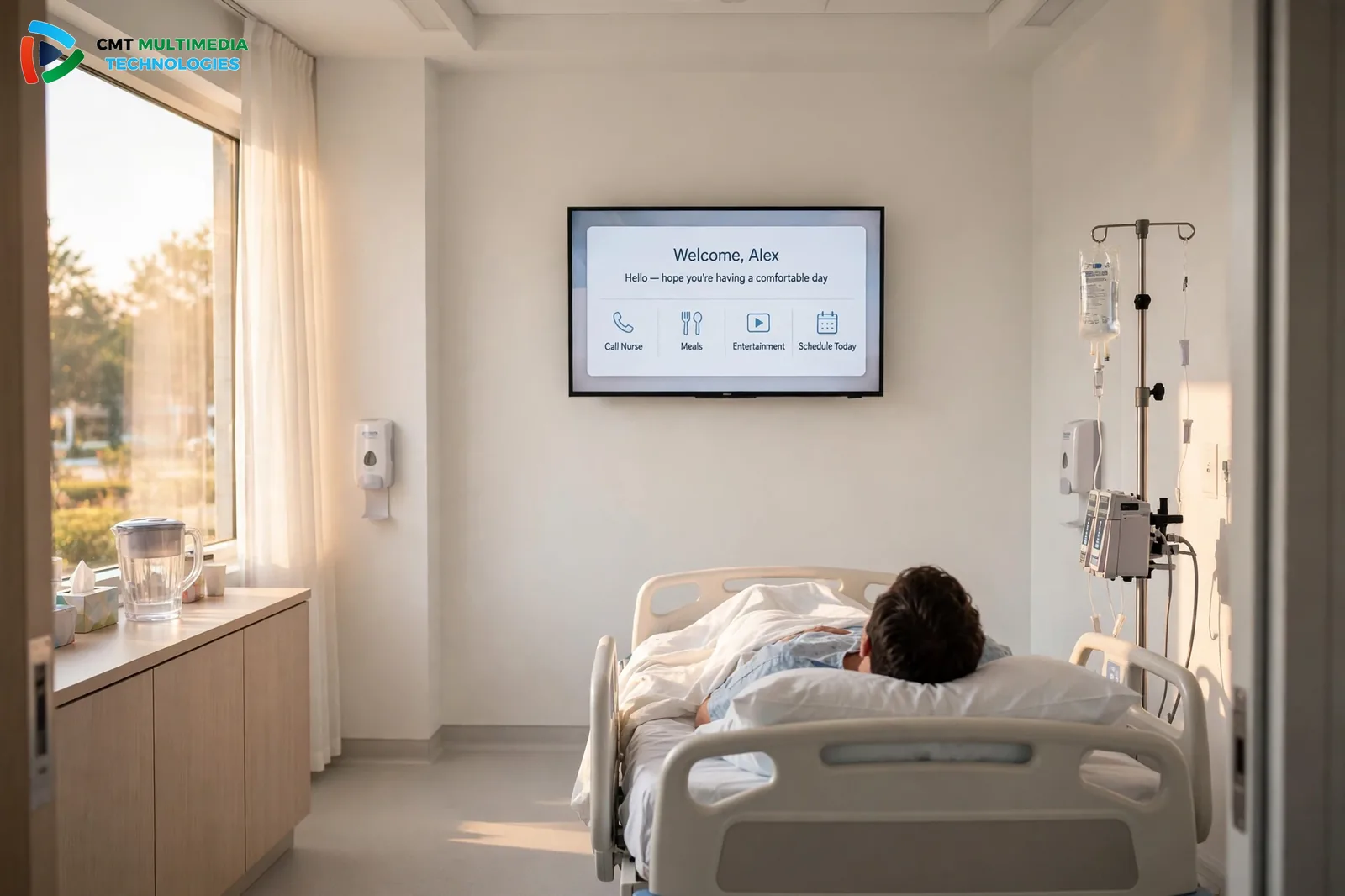
    Patient in a hospital bed watching the welcome screen on the wall-mounted bedside TV

    Patient education on the TV

    Hospital entertainment systems used to mean a few channels. Now the TV also teaches. Patient education videos play on demand, matched to the patient's condition: what the treatment does, how to take medicine, and what to do after discharge. Healthcare IPTV also carries videos for families, so they know how to help at home. Older patients get large text and slow, clear speech. In our experience, a patient who understands the plan asks better questions and worries less.

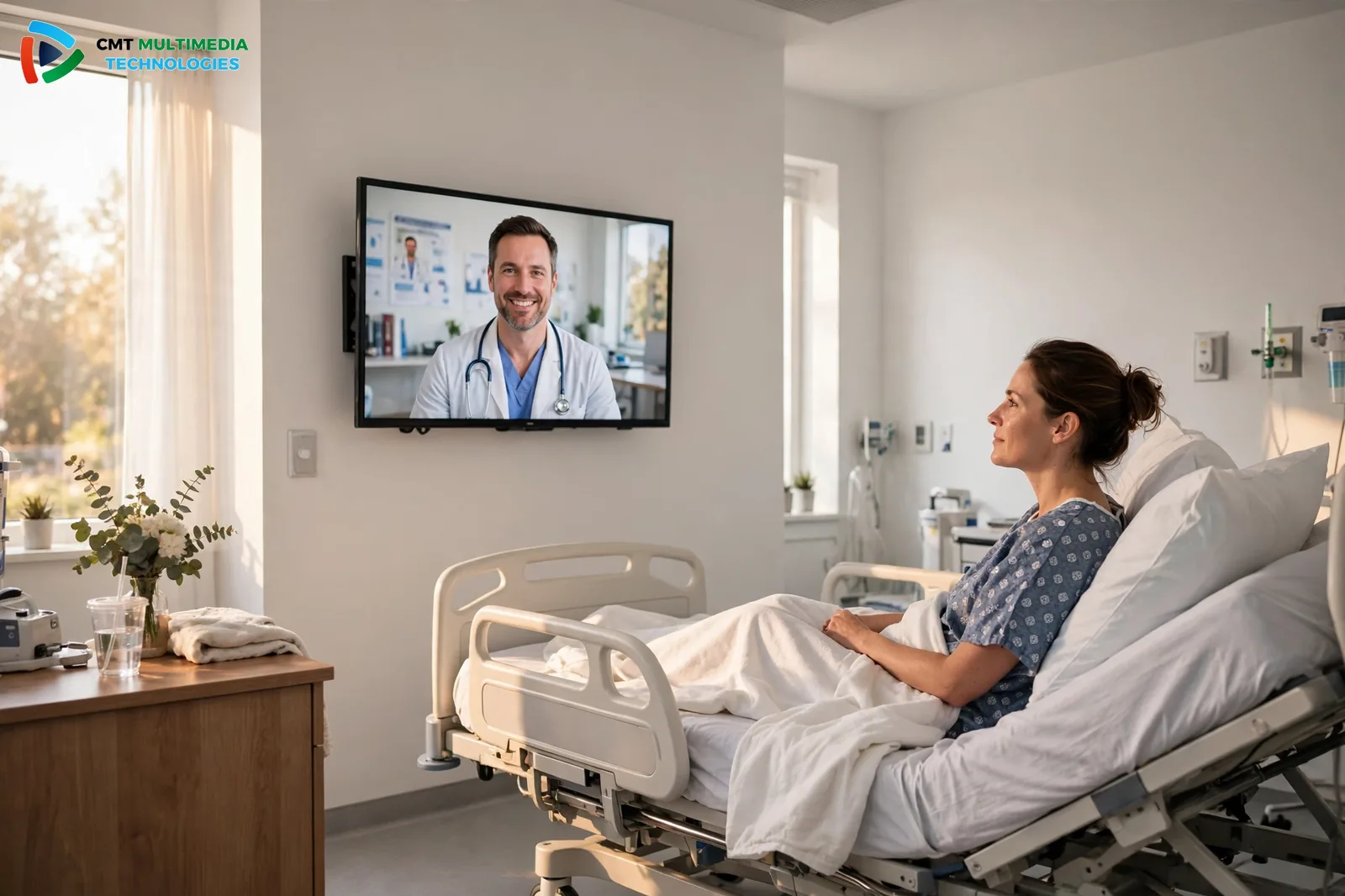
    Patient in a hospital bed on a video call with a doctor on the wall-mounted TV

    Video calls with your doctor

    This is telehealth on the TV, part of a healthcare IPTV solution for hospitals: the patient talks to the doctor by video, from the bed, without a trip across the hospital. Follow-up visits, test results, and second opinions can happen on the same screen. Families can also join by video call, so a daughter in another city can sit in on the doctor's update. In our experience, a short video call calms a worried patient more than a long wait in a corridor. The call is private: only the patient and the doctor see and hear it.

    Digital signage and wayfinding

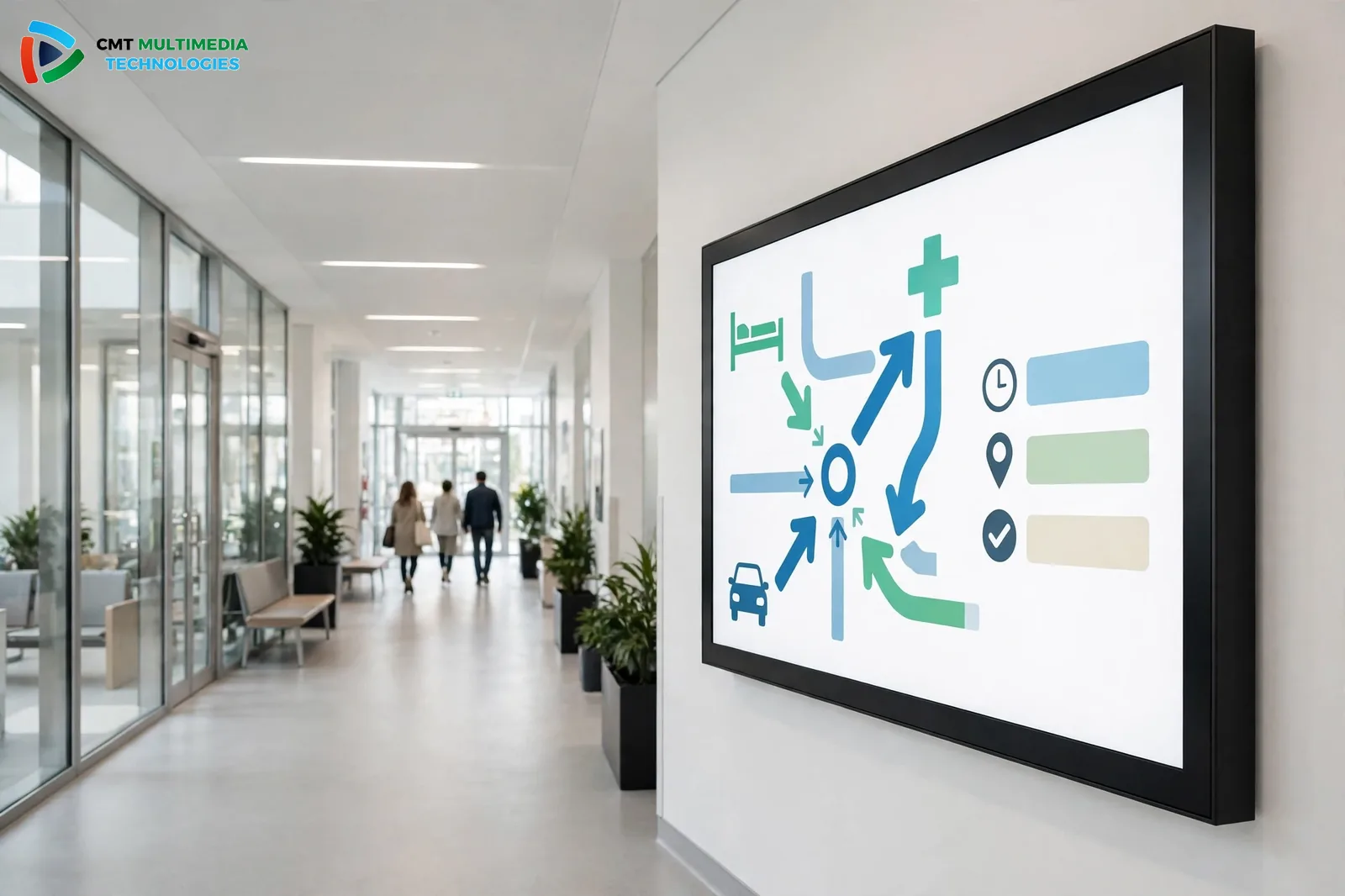
    Hospital digital signage is the second screen of a healthcare IPTV solution. Lobby screens show appointment boards, clinic directions, and health messages. A visitor reads the board and walks straight to the right ward, without asking at every desk. Wayfinding maps on the screens guide patients and families through large buildings. The same screens carry emergency messages to every floor at once. In our experience, clear signs cut the queue at the front desk.

    Wall-mounted wayfinding screen in a bright hospital corridor

    Prayer times, Qibla and pilgrim patients

    Hospitals in Makkah and Madinah serve patients from every country. Multilingual patient TV means menus and channels in the languages your patients speak, with prayer times on the screen and the Qibla direction for the room. Haram live broadcasts play on the room TV, so a patient who cannot leave the ward can still follow the prayers. In our experience, this matters most during Hajj and Umrah, when wards fill with pilgrim patients who speak many languages and need clear, simple screens. See our Makkah guide and our Madinah guide.

    HOSPITAL IPTV

    Care on every screen, in every ward.


    Bedside TV, patient education, video calls and signage, run as one hospital system.

    How it links to your hospital systems

    A hospital TV that stands alone is just a TV. A hospital IPTV solution links the patient TV to the nurse call and the records system, or staff do double work. Nurse call integration lets the patient call for help from the TV, and the call reaches the right nurse. EHR integration shows the care plan, the meal plan, and the schedule on the patient's own screen. Meal orders from the TV go to the kitchen with the right room number. In our experience, the link to the records system is where most projects are won or lost, so we plan it first, not last.

    New hospital or existing wards?

    Hospitals ask us one question more than any other: does this work in a hospital that is already open? The short answer is yes. A TV for hospital rooms is not the same as a TV for a living room, but the install follows the same idea: wards are done one at a time, and no ward closes. A hospital IPTV solution is installed in steps: one ward first, then the next, until the whole hospital is live. New hospitals can plan the full system from the start.

    Old way

    Cable TV in each room, printed notices on the wall, and a different system in every ward.

    New way

    One IP system for every screen, the same welcome screen in every room, and wards added one at a time without closing.

    What affects the cost?

    Hospitals ask what this costs. The price changes with the hospital, so we do not list fixed prices here. Healthcare TV solutions are priced by the project, not by a list. Five things set the cost: (1) the number of rooms and beds, (2) new build or retrofit, (3) wired or wireless, (4) how many screens and signage boards you need, (5) how many of your own systems must link to the platform. A small clinic with the room TV only costs less than a large hospital with the full system. Request a demo and we will price your hospital after we see the wards and the systems you need.

    How to choose a hospital IPTV supplier

    Choose a hospital IPTV supplier who knows hospitals, not just screens. The best hospital IPTV solutions come from a partner who knows hospitals, so ask five things before you sign: (1) does it link to your patient records and nurse call, (2) is patient data safe, (3) who supports you after install, (4) can it show many languages and prayer times, (5) can it grow when you add wards. Most systems look alike in a brochure. The difference is the partner behind them. Ask for a demo in a real ward before you decide.

    Healthcare IPTV in the UAE and Saudi Arabia

    The Gulf is building hospitals fast, and healthcare IPTV in the Middle East is now part of that build. New hospitals want the TV by the bed from day one: welcome screens, patient education, video calls, and signage. Older hospitals want to add the same system without closing wards. CMT Technologies works in the UAE and Saudi Arabia, and the same team serves hospitals in both countries. Oman is part of the same Gulf service: hospital IPTV in Oman runs on the same platform as the UAE and Saudi Arabia. See our Saudi Arabia guide, hospital IPTV in Dubai, and hospital IPTV in Abu Dhabi.

    Our Technology Partners

    Case Studies

    See how our IPTV and OTT solutions work in real hotels, hospitals and venues.

    Our Solutions

    The CMT Technologies core product line is based around IP TV Solutions.

    Questions hospitals ask

    Healthcare IPTV is the TV system for hospitals and healthcare facilities: live channels, films on demand, patient education and hospital information on the TV by the bed. It is a hospital IPTV solution built for healthcare, not a hotel TV.

    It is the TV system that serves patients, visitors and staff in a hospital, over the hospital’s own network.

    Patients can watch live TV and films on demand, order meals, call the nurse, and see their schedule for the day, all from the TV by the bed.

    Yes. Family video calls run on the room TV, so a relative in another city can join the doctor’s update or just say hello.

    Yes. The system links to the hospital’s patient records and nurse call, so the care plan, meal plan and schedule show on the patient’s own screen.

    Yes. Wards are done one at a time, and no ward closes during the install.

    Five things set the cost: the number of rooms and beds, new build or retrofit, wired or wireless, how many screens you need, and how many of your own systems must link to the platform. We price each hospital after we see the wards.

    Menus and channels in Arabic, English and other languages, with prayer times on the screen and the Qibla direction for the room.

    Yes. Streams are encrypted, each patient sees only their own information, and the welcome screen resets when a patient leaves, so the next patient starts fresh.

    See it in your hospital

    Request a demo and we will show the full system in a real ward.