

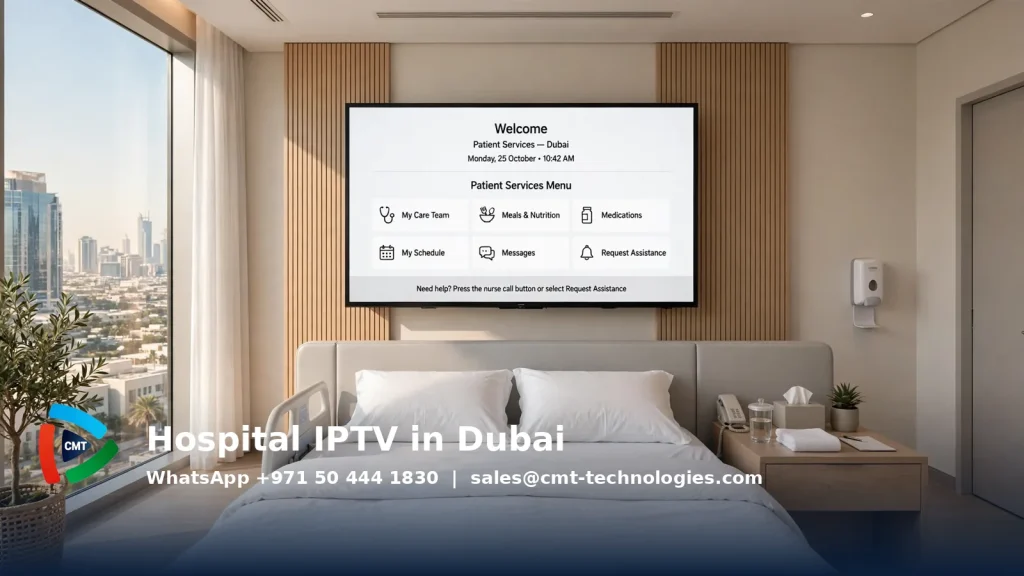
Live TV, on demand viewing and patient education on every room television, managed from one dashboard.
Hospital IPTV in Dubai gives every patient room a clear television service: live channels, on demand viewing and health education, managed from one system. CMT Technologies builds these systems for hospitals and clinics across Dubai and the UAE, alongside our hospital work in Riyadh.
A hospital stay is mostly waiting. Between rounds, tests and visiting hours, the patient is alone in one room with one screen, and that screen shapes how the whole stay feels. A confusing channel list with no guide adds frustration at the worst possible time, while a clear service in the patient's own language calms the room within minutes. That is the real job of hospital television, and it is why Dubai's hospitals now treat it as part of patient care, not as an extra.
This page explains what a hospital IPTV system includes, what patients and hospitals each get from it, how it works behind the scenes, and what it costs. The same hospital IPTV in UAE platform serves clinics across the Emirates, with Dubai hospitals as its largest base.
The television opens on a welcome screen with the hospital's name, prayer times and useful information, not on a blank channel list. From there the patient finds live news, sport and films from home, plus hospital information in the same menu, so one remote covers everything in the room.
Meal ordering, prayer times, visiting hours and discharge information all sit on the welcome screen, so patients ask staff fewer repeated questions. A patient who knows when the next meal arrives and when visiting starts feels settled, and settled patients call the nurse station less.
Patient education runs on the same screen. Before surgery or after treatment, the care team can assign short videos that explain the procedure, the medicine routine and the recovery steps. The television works as the hospital's patient entertainment system, so patients watch at their own pace and rewatch whenever they need, which helps families understand the care plan too.
Language matters most in Dubai. Menus run in Arabic first with English alongside, and channel packages cover the languages the city's mixed patient base actually watches. An older patient who cannot read a complicated menu can still find prayer times and the news channel without help.
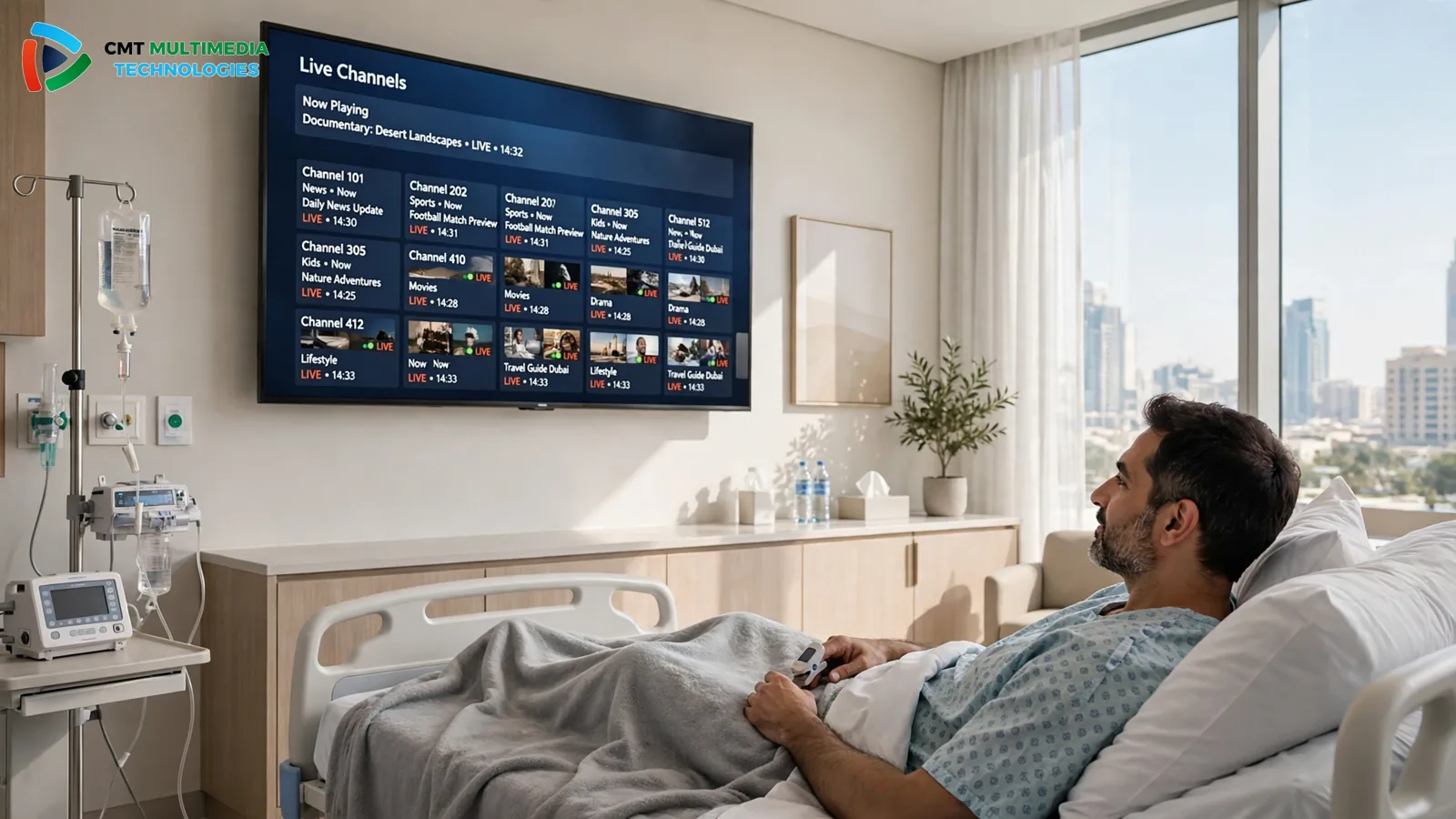
Saudi, Gulf and international channels with an Arabic first guide, so every patient finds something familiar.
Short videos that explain procedures, medicine routines and recovery steps, assigned by the care team.
Patients play their own phone content on the room TV safely, disconnected automatically at discharge.
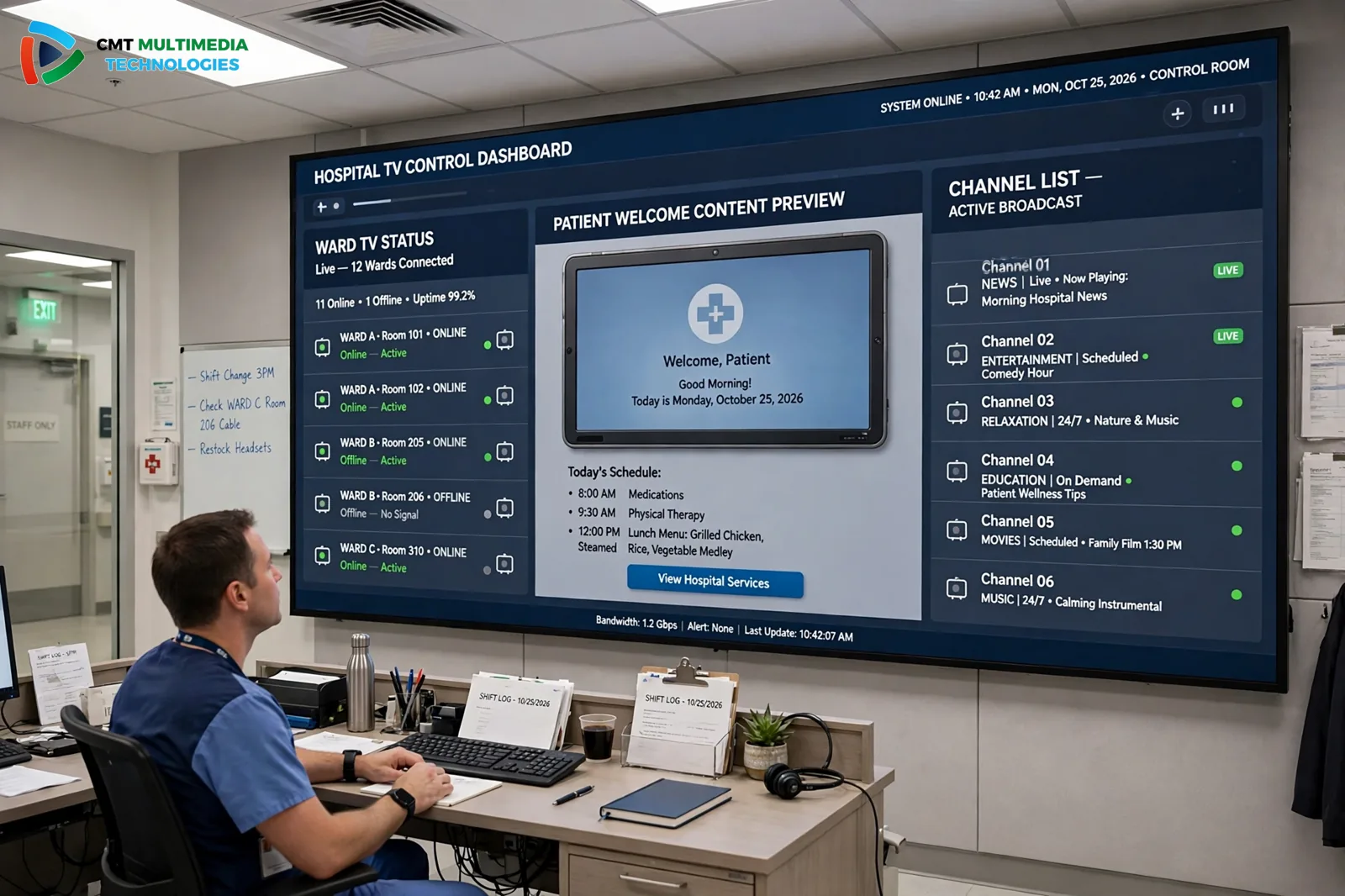
Channels, welcome screens and messages change from one dashboard, without visiting each room.
Every screen in the hospital is controlled from one dashboard. Channels, welcome screens, education videos and messages change in minutes, without visiting each room, so a hospital with hundreds of beds runs its televisions with the same effort as a small clinic.
An IPTV system for hospitals must handle this scale, and each ward keeps its own settings, so a maternity ward and a surgical ward can run different menus on the same platform. A children's ward can carry kids channels all day while a surgical ward carries quiet films in the evening, and neither ward disturbs the other.
Own branding stays on every screen. The welcome screen carries the hospital's name, colours and information, even though the platform underneath is shared across wards. Multilingual menus serve Dubai's mixed patient base, with Arabic first and English alongside.
The system works with hospital grade smart TVs from LG, Samsung, Philips, Sony and Panasonic, with a set top box where an older screen needs one. This is the practical side of IPTV for hospitals: the screen choice fits the ward, and integration with nurse call and hospital systems is available where the hospital wants it, so patient information stays accurate and up to date.
One short demo shows the welcome screen, the dashboard and the patient experience on a real room television.
Three parts make the system work: a central server, the hospital's own network, and the screens in the rooms. Channels and on demand content arrive at the server, travel over the hospital network, and appear on each room television through an app or a small set top box.
Most hospitals need no new cabling, because the system runs on the network the building already has. Where the network needs strengthening, the survey finds it before any installation begins, so there are no surprises halfway through the work.
The dashboard is where the hospital's team spends its time. Staff update welcome screens, push a message to one ward or the whole hospital, assign an education video to a single room, and watch every screen's status in real time. A screen that goes offline shows up immediately, and most faults are fixed remotely before the patient notices anything.
Patients can play their own phone or tablet content on the room television safely. Connection takes seconds over the hospital network, and everything disconnects automatically at discharge, so nothing personal stays behind.
This matters more than it sounds. Families use the same screen for video calls with relatives abroad, and a patient in a long stay watches familiar films instead of whatever happens to be on. Casting turns the room television from a hospital fixture into the patient's own screen, which is exactly what people ask for by name now.
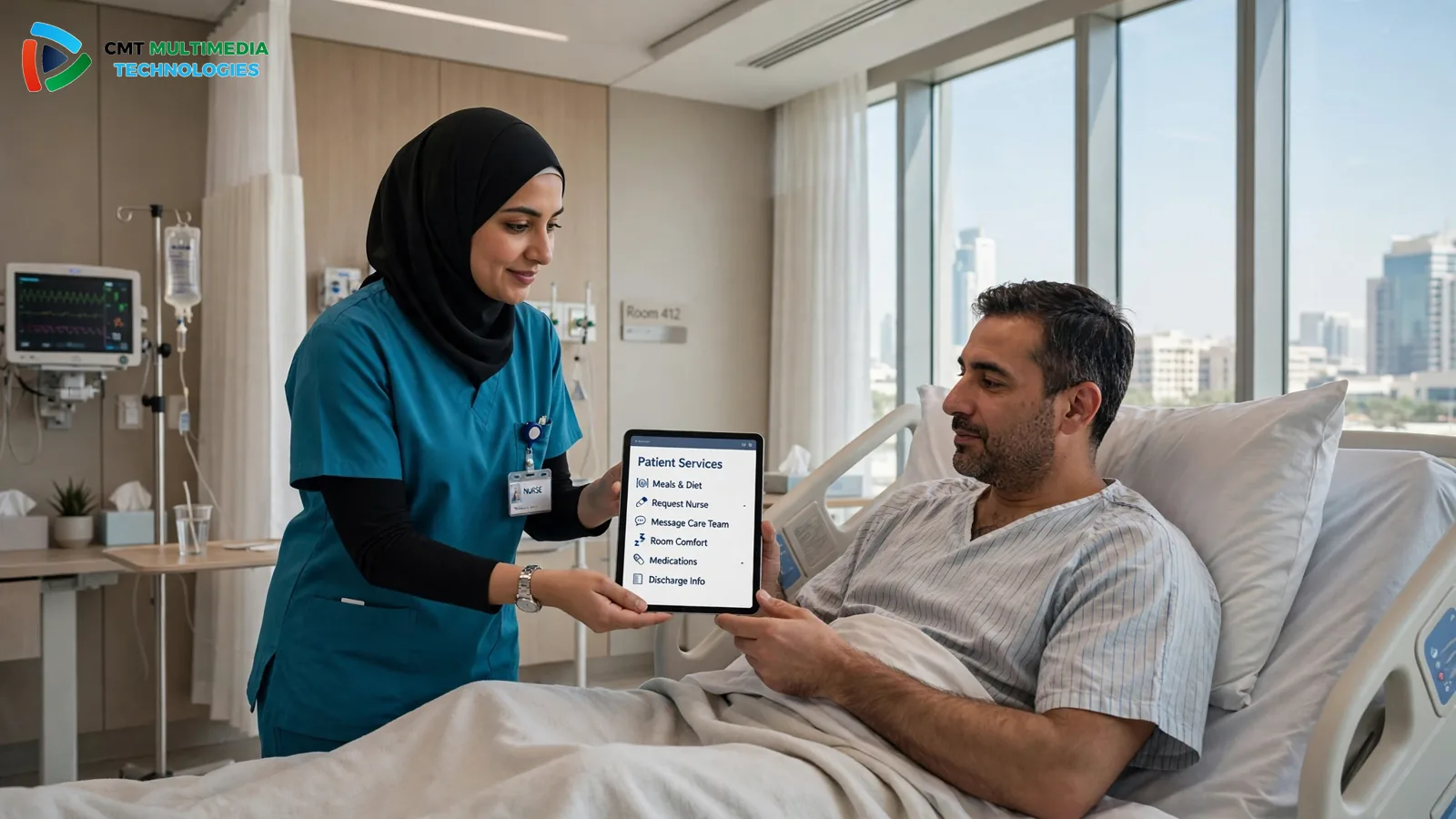
Bedside tablets give patients meal ordering, feedback forms, education videos and hospital information without touching the television remote. Nurses update menus and messages from the same dashboard, so the tablet and the television always show the same information.
Tablets suit patients who struggle with a remote, including older patients and anyone lying flat after surgery. A large touch screen with clear buttons is easier than small remote keys, and the hospital gets honest feedback through the tablet's survey form instead of hearing complaints only at discharge.
The system fits any hospital where patients spend nights in beds, and each type of hospital uses it differently:
Full wards with mixed patients, where central control and multilingual menus matter most.
Calm menus, kids channels for siblings, and education videos for new mothers.
Short stays where a simple welcome screen and clear discharge information speed up turnover.
Long stays where on demand films, education videos and casting keep patients comfortable for weeks.
Small clinics start with a few rooms and grow later, because the platform scales room by room without replacing what is already installed.
Installation runs in phases, so no ward closes for the work:
We visit the hospital, review the network and count every screen position, including wards, private rooms and suites.
You approve the screen plan, the welcome design and the price before any work begins.
One ward goes live first, so the hospital sees the real patient experience before committing the rest.
Wards join in phases, with each ward live within days of its own installation.
Staff learn the dashboard in one short session, and monitoring stays on after handover.
Phased rollout keeps revenue safe, because beds stay open throughout, and timing around busy periods protects peak weeks.
The price depends mainly on four things: how many rooms the hospital runs, how much of the network already exists, whether rooms need new smart TVs or only set top boxes, and which channel packages and casting licences the hospital chooses. A new build with smart TVs and modern cabling needs far less equipment than an older property starting from coax wiring.
Most hospitals phase the spending ward by ward. The pilot ward goes live first, then the busiest wards follow, and the remaining wards join as budgets allow. CMT quotes one clear figure per phase, so there are no surprises halfway through the work.
CMT Technologies has delivered IPTV for healthcare projects across the UAE and Saudi Arabia for more than eighteen years. That record includes healthcare IPTV systems in Dubai and Riyadh, alongside national platforms in the Kingdom.
For hospitals comparing IPTV providers in the UAE, the practical difference is simpler. You deal with one team for the survey, the installation and the support afterwards, and the person who answers knows your hospital. As a result, problems get solved in hours rather than passing between suppliers.
Support is available in Gulf working hours, every day, and monitoring watches the system around the clock. For the full service behind this page, see IPTV in Saudi Arabia.
Live channels, on demand viewing and patient education on every room television, plus welcome screens, meal ordering information and hospital messages, all managed from one central dashboard.
Yes. Menus run in Arabic first with English alongside, and channel packages cover the languages Dubai's mixed patient base actually watches.
No. The television opens on a simple welcome screen with channels, prayer times and hospital information, so most patients use it without any explanation from staff.
Yes. Patients play their own phone or tablet content on the room television safely, and everything disconnects automatically at discharge, so nothing personal stays behind.
Monitoring watches the system around the clock, and most faults are fixed remotely before your team notices them. Support is available in Gulf working hours, every day.
Often yes. Newer smart TVs run the service through an app, while older screens connect through a compact set top box. A survey confirms what each room needs.
A pilot ward goes live within days of its own installation, and the full hospital follows ward by ward. The survey gives an exact timeline before any work begins, and no ward closes during the rollout.
The price depends on room count, existing network, screen type and channel packages. Most hospitals phase the spending ward by ward, and CMT quotes one clear figure per phase.