Application development for multiscreen is the work of building one app that runs on TV, phone, tablet, web and set-top box.
Your viewers watch on many screens now. They start a film on the TV at home, watch part of it on the phone, and finish it on a tablet. They expect the same app on each screen, and they expect it to remember where they stopped. See our IPTV OTT solutions for telecom, our OTT solutions, and our solutions.
A viewer owns more than one screen, and each screen works in a different way. A TV is watched from across the room with a remote. A phone is held in the hand and touched. A tablet sits on a lap. A web player runs in a browser, and a set-top box answers to a remote and a TV guide. One app must fit all five. CMT Technologies offers multiscreen app development for clients who want one service on every screen. Here is the full set, in plain words.
Smart TV app development for the big screen, built for the remote and for reading from across the room.
Apps for phones, built for touch. Watch on the move, and pick up where you left off.
Apps for tablets, built for the lap and the sofa. Big enough for a film, light enough to carry.
Apps that run in a browser, with no download. Open a link and watch, on a laptop or a desktop.
Apps for the box under the TV. Live TV, the TV guide, and films on demand, all on the remote.
A white-label app means the app carries your brand, not ours. Your viewers see your name, your colours, and your logo on the TV app, the mobile app, and the web player. When the app looks and feels like your service, viewers treat it as yours. You keep the customer relationship, and we build the white-label apps and support your team.
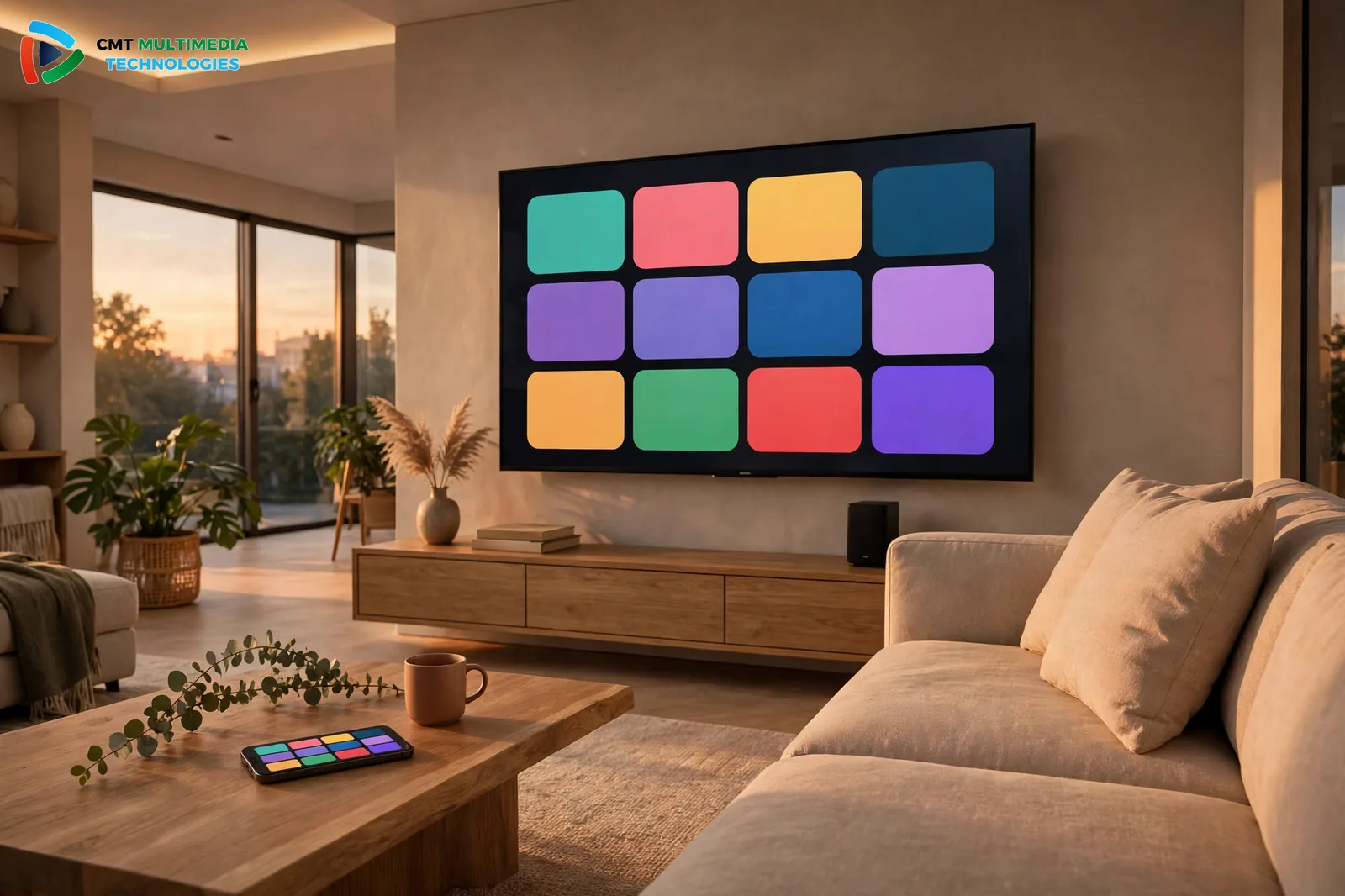
Multiscreen is not an all-in-one app. It is one app with many views. The basic app is built once, then it is packaged with templates and extra features made for each screen. The TV view has big tiles and simple remote navigation, and the phone view has touch menus and a small player. The result can be a single app with multiple views, or many apps built from the same base app. This is cross-platform app development in plain words: one base, shaped for each screen, instead of five separate projects. A single codebase holds the shared parts, so a fix or a new feature goes out to every screen at once. A viewer starts a film on the TV and finishes it on the phone. That is continue watching, and it works only when every screen talks to the same service.
We build your app in five steps, in order.
We agree the screens, the features, and the content for your viewers.
We design each screen for how it is used. Big tiles for the TV, touch menus for the phone, a clear layout for the web.
Our in-house partner team builds the apps from the one shared base, and links them to your platform: live channels, films on demand, and viewer accounts.
We test on real devices in our test lab, throughout the life cycle, before anything goes live.
We handle app store submission for each store and TV platform, and we stay with you after launch.
Building for the TV takes the most care in step two, because a TV app answers to a remote, not to touch. We plan for that from the first screen, not at the end.
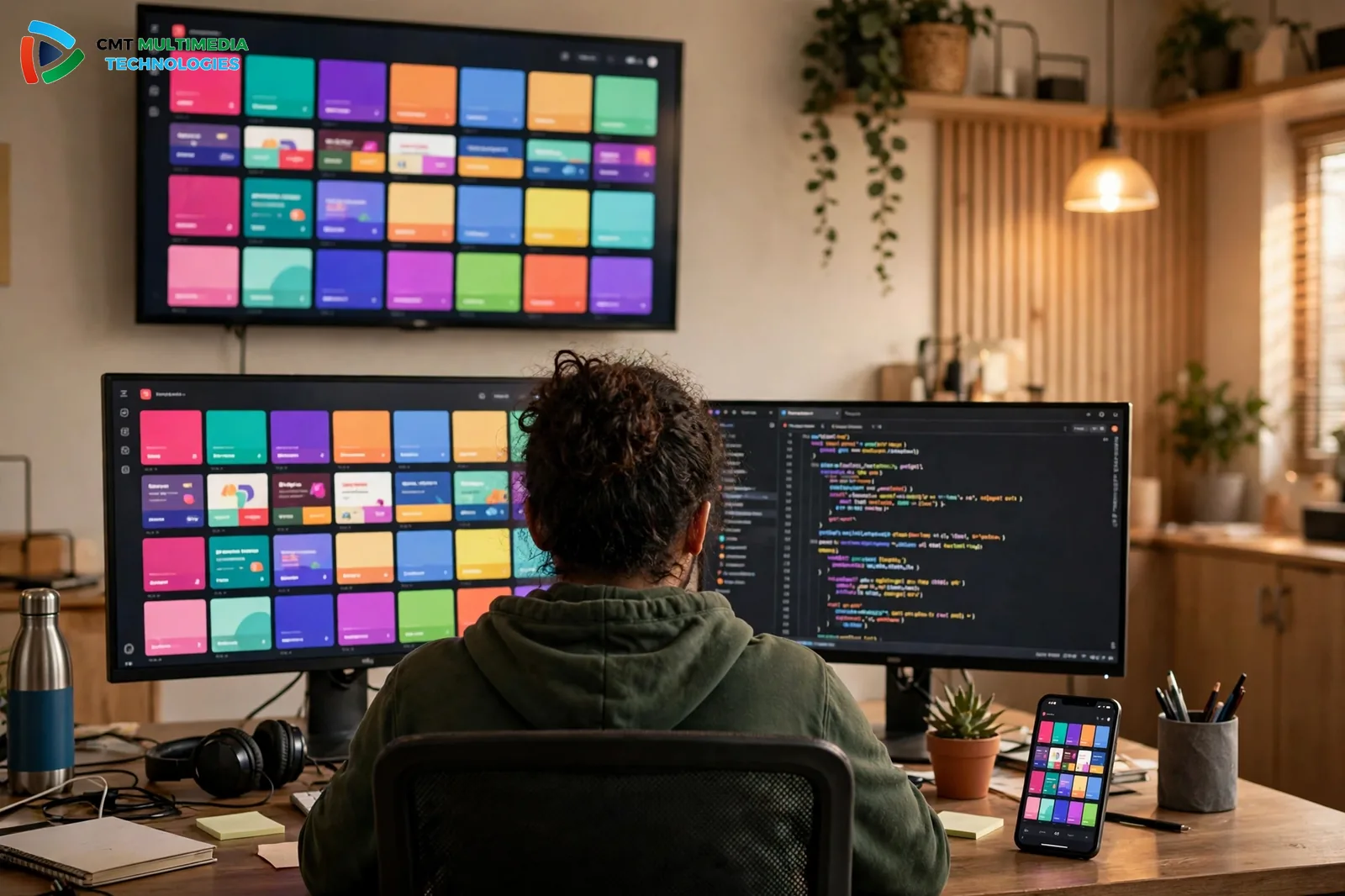
An app that works on one phone can fail on another TV. Screens differ in size, memory, and software. That is why we test on real devices, not only on a computer screen. CMT Technologies runs a fully equipped test lab with an extensive range of devices, where dedicated testers prove the apps throughout the life cycle. This app testing on real devices covers the TV, the phone, the tablet, the web player, and the set-top box, on the screens your viewers actually own. In our experience, the faults found in the lab never reach your viewers. CMT Technologies has focused on multiscreen and OTT solutions since 2009.
Multiscreen Apps
We build the app once and shape it for TV, phone, tablet, web and set-top box.
An app is only the front of the service. Behind it sits the platform that makes the video play, keeps it safe, and takes the payment. The video on demand platform holds the films and shows, so viewers pick what to watch and when. The IPTV EPG holds the TV guide. IPTV middleware is the control room behind the apps: it holds channels, channel packages, devices, and who can watch what. A content delivery network carries the video to viewers in real time, anywhere in the world. DRM solutions protect the channels and films you carry, so only the viewers who should watch can watch. Pay-per-view lets viewers pay for one match or one film. See our broadcasting solutions for live TV at scale. OTT app development covers all of this.
Many companies already have apps, but they were built one screen at a time. The TV app looks different from the phone app. Moving to one app with many views does not mean switching everything off in a single night. We move it in steps: the shared base first, then one screen at a time, until the old apps go quiet. In our experience, a phased move is the only safe way. A single-night switch risks a dark screen for every viewer at once.
Five projects, five designs, five fixes. A change on one screen never reaches the others.
One base, shaped for each screen. A fix or a new feature goes out to every screen at once.
Clients ask what this costs. The price changes with the project, so we do not list fixed prices here. Five things set the cost:
Request a demo and we will price your project.
Choose an app development partner who knows video, not just apps. Ask five things before you sign: (1) does it build for TV as well as phone and web, (2) does it test on real devices before launch, (3) does it link the apps to your platform and payments, (4) who supports you after launch, (5) can it grow when your audience grows. Your name is on the app, so the partner behind it must be one you trust.
The Gulf is a strong market for multiscreen apps. Fibre reaches more homes every year across the UAE, Saudi Arabia, Qatar, Kuwait, and Bahrain, in cities like Dubai, Abu Dhabi, Riyadh, Jeddah, Doha, Kuwait City and Manama. Viewers here watch in Arabic, English, and many other languages. The services that win offer a local lineup: Gulf channels, Arabic and English films, and channels for the many nationalities that live here. A multiscreen OTT platform means one service, not four: a viewer starts a film on the TV at home and finishes it on the phone, and the service remembers where they stopped. CMT Technologies builds multiscreen apps for hospitality, health, telecom, education, and smart city clients across the Gulf, and plans them around Gulf viewers and Gulf networks.
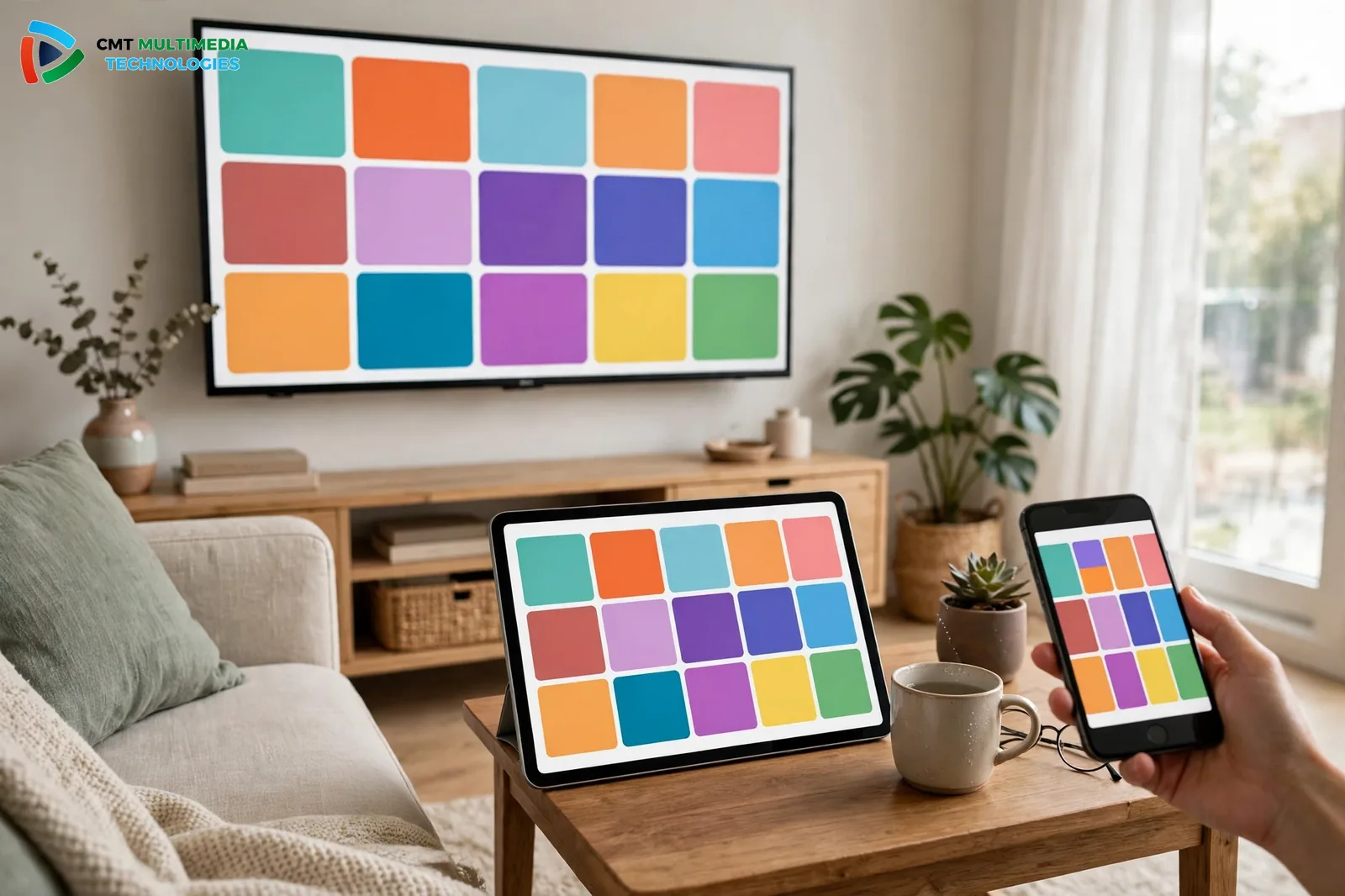







Application development for multiscreen is the work of building one app that runs on TV, phone, tablet, web and set-top box: the same service, shaped for each screen.
One app, many views means the basic app is built once, then packaged with templates and extra features made for each screen.
The app can run on Smart TV, mobile, tablet, web and set-top box.
Yes. The app is white-label, so your viewers see your name, your colours and your logo on every screen, while CMT Technologies builds and runs the technology behind it.
Yes. We test on real devices in our fully equipped test lab, where dedicated testers prove the apps before anything goes live.
Content protection uses DRM to make sure only the right viewers can watch, and watermarking to trace a leak back to its source.
Yes. We move it in steps: the shared base first, then one screen at a time, until the old apps go quiet. Viewers keep watching through the move.
Five things set the cost: how many screens the app must run on, how many need a native build, how much of the platform behind the app must be built or linked, how much design work each screen needs, and how much testing and store submission it needs.
Request a demo and we will show you an app running on TV, phone, tablet and web, under your brand.
Request a DemoContact