
logo

    Name

    Email

    Contact No.

    Message

    Follow Us:

    Content Watermarking Solutions

    Content watermarking solutions protect video and audio with a small invisible mark, so every leak can be traced back to its source.

    Content watermarking solutions protect video and audio by hiding a small invisible mark inside each copy. When a copy leaks, the mark shows where it came from. CMT Technologies supplies this protection for broadcasters, telecom operators, hotels, and OTT platforms across the Middle East. On this page, see how it works, what it protects, and how to choose a provider.

    Video is easy to copy. A live match, a new film, or a training video can be shared in minutes. Locks help, but once a copy is out, the lock is gone. That is the gap watermarking fills. It does not lock the video. It marks it, so every copy can be traced back to its source. CMT Technologies is a video watermarking solutions provider for the Middle East, and we build this protection into the end to end OTT systems we already install. It comes as part of an IPTV turnkey solution, with the DRM and the mark built in. That includes the IPTV solutions for hotels that CMT Technologies installs across the region. You can also see our work for IPTV in the Middle East, our hospitality IPTV, and all our IPTV and OTT solutions.

    What content watermarking protects

    Watermarking protects the content that is worth the most.

    Live sports and events

    A live match is worth the most while it is on, and a leak during the match hurts at once. Watermarking marks each live stream, so a pirate feed can be traced while the event is still live.

    Films and series on demand

    Films and series leak from pre-release copies and streams. Each copy carries its own mark, so the source can be found.

    IPTV and OTT streams

    On a multiscreen OTT solutions platform, OTT content protection covers streams on phones, TVs, and boxes. Each viewing session gets its own invisible mark.

    Audio and music

    Audio carries a mark too. The mark is silent, and it stays even after the file is compressed or converted.

    Forensic watermarking: find the leak

    Forensic watermarking is the kind of watermarking that finds the source of a leak. It hides a unique ID inside each copy of the video. The ID is tied to one account, one device, or one viewing session. Viewers cannot see it, and the picture does not change. This is dynamic watermarking: every copy carries a different mark. When a copy turns up on an illegal stream or a pirate site, our team takes a short sample, reads the mark, and matches it to the account it came from. That is video leak tracing in plain words: find the copy, read the mark, name the source. Then the operator can act: stop the stream, close the account, or send a takedown notice with proof. In our experience, the mark alone is not enough. It must sit inside a full protection plan, with monitoring that finds the leak fast and a clear step to act on it.

    Living room TV showing a live football match with players in red and white kits
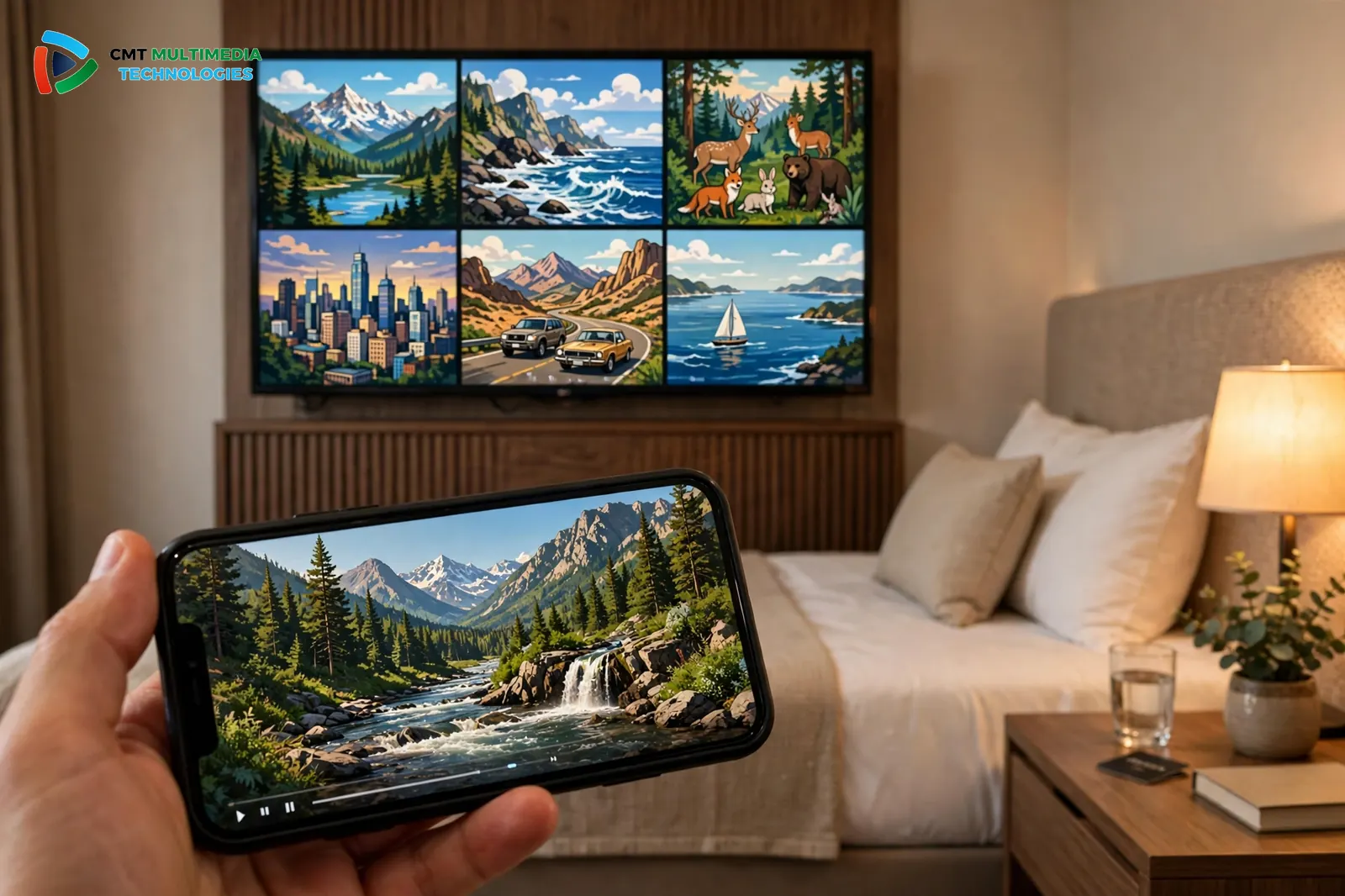
    Living room TV showing a grid of nature scenes, with a phone in hand streaming a mountain stream

    Watermarking for IPTV and OTT

    Forensic watermarking for IPTV works on live channels and on-demand libraries alike, and every IPTV OTT solution we build carries the mark. Live stream watermarking adds the mark as the stream is prepared, one mark for each viewer session. OTT watermarking works the same way for apps and web players. The mark is invisible, and the viewer sees no change in quality. If that stream is captured and shared on an illegal IPTV service, the mark points back to the account it came from. The same mark protects patient TV too, and hospital IPTV carries it on every channel. This is anti-piracy watermarking at work: not a lock on the front door, but a trail back to the source. For enterprise IPTV solutions, the same marking protects training video and internal content. It fits the IPTV solutions for operators that CMT Technologies builds, and it works with the DRM and delivery systems the operator already uses. See our telecom IPTV and OTT solutions.

    Watermarking for broadcasters and distributors

    Video watermarking for broadcasters starts before the content reaches the public. Pre-release copies, screeners, and partner files each carry their own mark. That is distributor watermarking: one mark per partner, per copy. If a screener leaks before release, the mark shows which copy leaked. The same mark follows the content through broadcast content management, from the studio, to the distributor, to the channel. In our experience, most leaks happen before release, so this early marking matters more than most buyers expect. It also helps with licensing: the mark proves which partner received which copy. These are the same IPTV solutions that feed broadcast and live production workflows at CMT Technologies. See our broadcasting solutions and live production and video streaming.

    Audio watermarking

    Invisible watermarking works for sound as well as pictures. CMT Technologies works with Activated Content watermarking technology, a patented system that carries data inside the audio itself. The mark is inaudible: listeners hear nothing different. It survives compression, encryption, transmission, duplication, and conversion. It is invisible to audio analysis, and it cannot be removed without damaging the original audio. That makes it a strong fit for music, radio, podcasts, and the audio track of any video. In our experience, buyers forget audio and protect only the picture. A leak can carry audio alone, so both need a mark.
    Audio watermarking in a broadcast studio, inaudible to listeners

    DRM, watermarking, and fingerprinting: what each one does

    Video content protection needs more than one layer. DRM and watermarking are often mixed up. They do different jobs, and a strong setup uses both. Here is the difference in plain words.

    CONTENT WATERMARKING

    Trace every leak to its source.


    Forensic marks on every stream, so a leaked copy leads back to its source.

    DRM

    DRM controls who can watch. It locks the content and hands out keys to paying viewers. Once a copy is out, DRM cannot help: the copy is already unlocked.

    Watermarking

    Watermarking marks each copy. It does not stop copying. It shows where a leaked copy came from, so the operator can act on the source.

    Fingerprinting

    Fingerprinting reads the content itself and matches it to a known file. It finds copies online, but it cannot say which account leaked them.

    Use DRM to control access, watermarking to trace leaks, and fingerprinting to find copies. Our cyber security solutions sit beside this protection.

    What affects the cost?

    Watermarking has no fixed price: every setup is different. Five things set the cost: (1) live or on-demand, live needs faster marking; (2) the number of channels or titles; (3) server-side watermarking or client-side marking; (4) whether monitoring and takedowns are included; (5) how it links to your DRM, CDN, and players. A small on-demand library costs less than a live sports service. Request a demo and we will price your setup after we see your content and your delivery chain.

    How to choose a watermarking provider

    Among IPTV solution providers, choose one who knows your delivery chain, not just the mark. Ask five things before you sign: (1) does it work with your IPTV, OTT, DRM, and CDN, (2) does it mark live and on-demand, (3) how fast can it trace a leak, (4) who acts when a leak is found, (5) who supports you after install. A good provider answers all five in plain words, never claims to be the best IPTV solution for every buyer, and shows a live demo on real content, not just slides. Ask for a demo on your own streams before you decide. Our media delivery runs on AWS Elemental Link, and watermarking fits into that chain.

    Content watermarking in the Middle East

    Content watermarking in the Middle East is growing fast. The region’s media and entertainment sector is the largest user of watermarking here, and the UAE and Saudi Arabia lead the way. UAE copyright law asks online platforms to protect content and fight piracy, so operators need real protection, not just a lock. CMT Technologies works from the UAE across the region: Saudi Arabia, Bahrain, Qatar, Oman, Kuwait, and Jordan, serving broadcasters and operators in Dubai, Abu Dhabi, Riyadh, Jeddah, Doha, Kuwait City and Manama. We install the watermarking inside the IPTV and OTT systems we build, including IPTV solutions for education, so the mark, the DRM, and the delivery work as one. The IPTV solutions Qatar operators use carry the same mark. See how we serve IPTV across the Middle East.

    Our Technology Partners

    Case Studies

    See how our IPTV and OTT solutions work in real hotels, hospitals and venues.

    Our Solutions

    The CMT Technologies core product line is based around IP TV Solutions.

    Questions about content watermarking

    Content watermarking is a way to hide a small invisible mark inside video or audio. The mark carries an ID. When a copy leaks, it shows where it came from.

    DRM controls who can watch by locking the content. Watermarking does not lock anything; it marks each copy so a leak can be traced to its source. Most setups need both.

    A well-made watermark is hard to remove without damaging the content. It survives compression, re-encoding, cropping, and format changes. No system is fully unremovable, so pair it with monitoring and quick action.

    No. A good watermark is invisible to viewers and does not change the picture or the sound. Viewers see no difference.

    It works for both. Live streams get a mark as they are prepared, and on-demand files get a mark before they are stored. Live sports is a strong use case, because a leak can be traced while the event is still on.

    Illegal IPTV services share streams taken from real accounts. A forensic mark in the shared stream points back to the account it came from, so the operator can stop that account and close the pirate feed.

    A/B watermarking splits the stream into short segments and makes two versions of each one, each with a different mark. Each viewer gets a unique mix, so every session has its own mark without re-encoding the whole stream for each viewer.

    It depends on the setup. Server-side marking works with any player, because the mark is added before delivery. Client-side marking needs support in the player app. We check your players first, then suggest the setup that fits.

    See it on your own content.

    Request a demo and we will show watermarking on your live streams and on-demand library.