

IPTV Middleware Solution for Enterprises in Makkah
Makkah is not a typical hospitality market. Every year, more than 18 million Umrah pilgrims arrive on top of the annual Hajj, and during peak religious seasons, hotels in the city operate above 85% occupancy. The pressure on in-room technology is extraordinary: guests from Indonesia, Pakistan, Turkey, Nigeria, Iran, and a hundred other countries expect their television to work in their language, on day one, without a single call to the front desk.
For enterprise decision-makers, hotel IT directors, hospital facilities managers, corporate building operators, the question is not whether to invest in an IPTV middleware solution in Makkah. It is which solution can actually handle that scale without cracking under the weight of Hajj season.
This guide covers everything procurement teams need to know before selecting an enterprise IPTV middleware platform for a Makkah facility.
What Enterprise IPTV Middleware Actually Does
Before comparing vendors, it helps to be precise about what middleware is and what it is not. The headend receives, decodes, and re-encodes television signals, satellite, terrestrial, or IP-sourced, and converts them into an IP stream that travels across the property's local network. That process alone does not give guests a useful television experience.
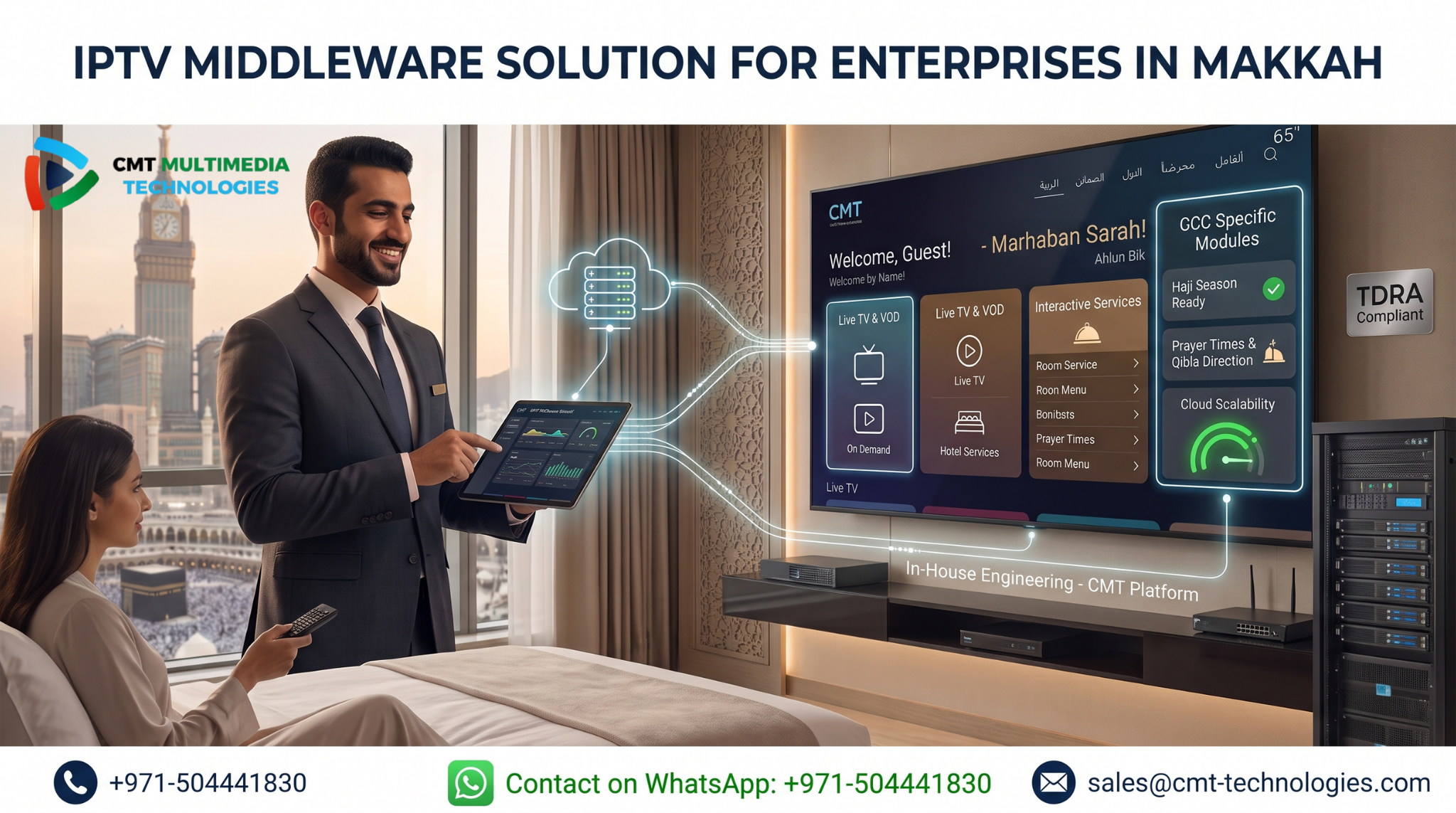
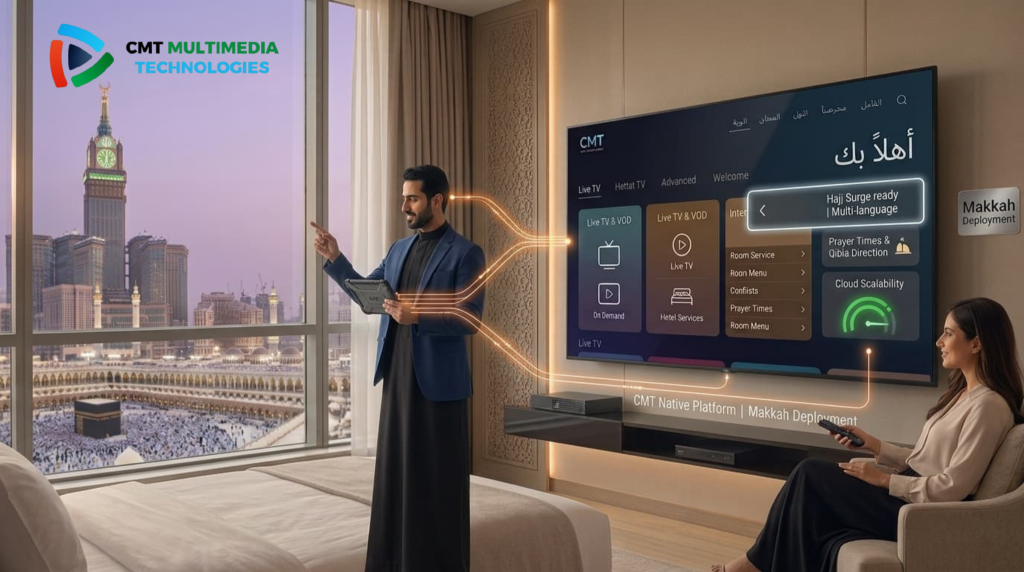
What they interact with, the channel guide, the welcome screen branded with the hotel's name, the on-demand movie menu, the ability to request housekeeping from the remote control, all of that is delivered by the middleware layer that sits between the headend and the display device.
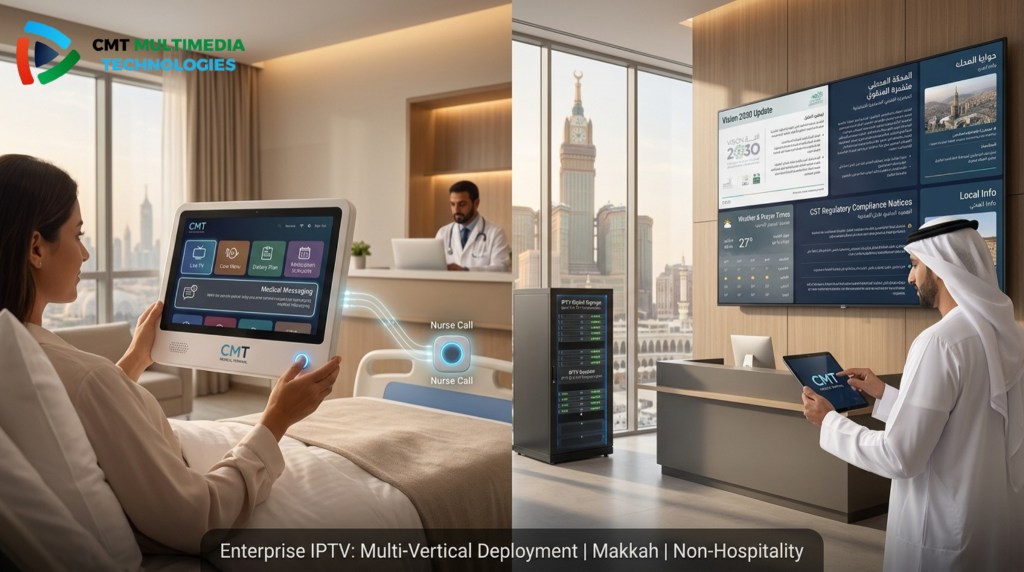
IPTV middleware is the software platform that manages content delivery, user interaction, device authentication, and integration with third-party systems. For enterprise clients in Makkah, those third-party integrations typically include property management systems (PMS) for hotels, nurse call systems for hospitals, prayer time displays, and multilingual content libraries that automatically switch interface language based on guest profile or manual selection.
The practical difference between basic middleware and an enterprise-grade IPTV middleware solution is the depth and reliability of those integrations at scale, and in Makkah, scale means serving hundreds of simultaneous guest rooms during the most demanding religious travel periods in the world.
Why Makkah Enterprises Face Specific IPTV Middleware Challenges
Most IPTV middleware products are designed for standard hospitality environments with steady, predictable occupancy. Makkah breaks almost every assumption those products are built around.
Guest Turnover at Pilgrimage Scale
The Western Region of Saudi Arabia generates 42.3% of total hospitality market revenues, anchored by Makkah and Madinah, where Hajj and Umrah activities produce sustained demand peaks with occupancy rates exceeding 85% during religious seasons. That occupancy figure translates into an almost continuous cycle of check-in and check-out during peak periods. Each room changeover requires the middleware to reset the guest profile, restore the default interface language, clear any personal preferences stored from the previous occupant, and re-authenticate the device, reliably, every time, without requiring IT staff to intervene manually.
A middleware platform without automated room reset processes will generate a disproportionate volume of front desk complaints during Hajj season, when staff are already stretched and language barriers make troubleshooting slower.
Language Diversity That Has No Parallel
In a normal pre-pandemic year, over 19 million Umrah pilgrimages were performed alongside approximately 2.5 million Hajj pilgrims. Those pilgrims arrive from virtually every Muslim-majority country on earth. An enterprise IPTV middleware deployment in Makkah that supports only Arabic and English will fail a significant proportion of guests before they have even unpacked. Effective middleware for Makkah needs to support Arabic, English, Urdu, Turkish, Bahasa Indonesia, Bahasa Malaysia, French (for West African pilgrims), and Hausa as a minimum practical requirement.
Investment Context
Investments totaling SAR 2.5 billion in Makkah hotel infrastructure reinforce the region's lead position, aligning with Saudi Arabia's Vision 2030 hospitality market growth targets. Properties being built or refurbished at this investment level are not looking for basic television distribution. They require enterprise-grade IPTV middleware that can support interactive services, revenue-generating on-demand content, real-time room service integration, and the kind of branded guest experience that justifies premium room rates, even during off-season, when religious tourism demand softens and competition for guests becomes fiercer.
Core Features of an Enterprise IPTV Middleware Solution for Makkah
Not every middleware feature matters equally in a Makkah context. The following capabilities are genuinely business-critical for enterprises operating in the city.
Property Management System Integration
PMS integration allows the middleware to receive guest data — name, nationality, language preference, check-in date, room tier, at the moment of check-in, and use that data to personalise the television experience automatically. For a Makkah hotel with 400 rooms turning over multiple times per week during Umrah season, manual configuration of each room television is operationally impossible. PMS integration is not optional; it is a baseline requirement.
The integration must handle both the check-in event (pushing guest data to the room) and the check-out event (resetting the device and clearing the profile). Any gap in this cycle produces the wrong language on the wrong screen, a small technical failure that feels like a significant hospitality failure to the guest encountering it.
Prayer Time Integration and Islamic Content
This is a Makkah-specific requirement with no real equivalent in any other hospitality market. Guests in the Holy City expect their room television to display accurate prayer times, ideally sourced from the official Umm al-Qura calendar rather than a generic prayer time database. The middleware should be able to overlay prayer time alerts, display the current Qibla direction, and provide live broadcast feeds from the Masjid al-Haram, all within the standard channel lineup without requiring guests to search for these features.
Enterprise middleware that does not account for this content requirement from the ground up requires significant customisation to deliver it, which adds cost and introduces integration risk.
Cloud-Based Architecture for Surge Resilience
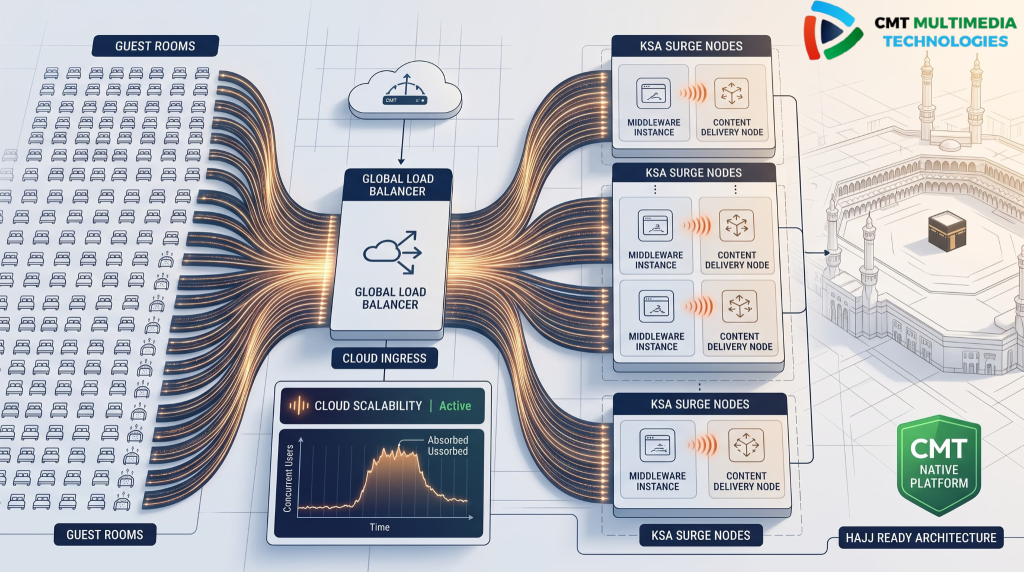
During Hajj and peak Umrah periods, a property's IPTV system must handle the maximum possible concurrent user load, every room television active simultaneously, with guests requesting content across the full range of languages and channel lineups. An on-premises-only middleware architecture that is sized for average occupancy will struggle under peak load. Cloud-based middleware removes this ceiling by distributing processing load and scaling resources dynamically based on actual demand.
CMT Technologies offers cloud-based IPTV middleware to enterprises in Makkah and across Saudi Arabia specifically because the cloud architecture eliminates the need for on-site server hardware that would otherwise need to be sized for the maximum possible load, a significant capital cost saving for properties that experience wide seasonal variation.
Multilingual EPG and On-Demand Content Management
The electronic programme guide (EPG) is the primary interface through which guests navigate the channel lineup. In a Makkah hotel where guests from thirty countries share the same physical infrastructure, the EPG must render correctly in right-to-left languages like Arabic and Urdu alongside left-to-right languages, with accurate channel names and descriptions in each language rather than a single-language default.
Managing this manually maintaining separate EPG data for each language, keeping it current as channels change, pushing updates to every device on the property, is a significant operational burden. Enterprise middleware with automated multilingual EPG management pulls data from a central source and handles the language rendering automatically per device.
Remote Device Management
An IPTV deployment across a 500-room hotel in Makkah involves hundreds of set-top boxes or Samsung Tizen Smart TVs. The middleware must allow IT staff to remotely diagnose, reboot, update firmware, and reconfigure individual devices from a central management console, without physically visiting each room. During Hajj season, when every room is occupied and physical access is impractical, remote device management is the difference between resolving a technical issue in minutes and leaving a guest with a non-functioning television for an entire day.
What to Evaluate When Selecting an IPTV Middleware Vendor for Makkah
Saudi Communications, Space & Technology Commission (CST) Compliance
Any IPTV content distribution system operating in Saudi Arabia that delivers broadcast content commercially must comply with the communications and broadcast regulations set by the CST. Vendors should be able to confirm their middleware architecture and content delivery configuration meets current CST requirements. Enterprises that deploy non-compliant systems carry the regulatory risk themselves, not the vendor.
Arabic Language Native Support
This sounds obvious but is frequently where vendors fall short. Native Arabic support means the middleware was designed from the ground up to handle right-to-left text rendering, Arabic EPG data, and an Arabic-language administrative interface, not that it merely accepts Arabic text as input in a left-to-right system. The practical difference shows up in every screen the guest interacts with.
Reference Projects at Comparable Scale
A vendor with a single 50-room boutique hotel as their largest Saudi Arabia reference project has not been stress-tested at Makkah's scale. Ask specifically for reference projects in the 300 to 1,500+ room range in high-occupancy KSA markets. CMT Technologies has confirmed deployments at this scale across Saudi Arabia, UAE, and the wider GCC.
Support Response SLA for KSA
Middleware issues during Hajj season when every room is occupied and guests have limited tolerance for technical failures require support response measured in minutes, not hours. Confirm the vendor's support SLA specifically for KSA clients, and whether they have on-ground technical resources in Saudi Arabia or rely entirely on remote support from another country.
PMS Compatibility
Makkah's large hotel properties operate on a range of property management systems, Opera, Protel, Infor HMS, and regional alternatives. Confirm the middleware vendor has a tested integration with the specific PMS the property runs, not just a claimed compatibility in their marketing materials.
CMT Technologies: IPTV Middleware Solutions for Enterprises in Makkah
CMT Technologies has delivered enterprise IPTV middleware solutions across Saudi Arabia since 2009, serving hotels, hospitals, corporate campuses, and educational institutions in the UAE, KSA, Qatar, Oman, and Kuwait. The company's cloud-based middleware platform is purpose-built for the multi-language, high-turnover operating environment that Makkah enterprises face.
Key capabilities relevant to Makkah deployments include automated PMS integration for guest profile management, native Arabic and multilingual EPG support, prayer time display and Qibla direction integration, Hajj-season surge capacity through cloud-based architecture, remote device management for STB and Samsung Tizen deployments, and on-ground support resources in Saudi Arabia.
Ready to Discuss a Makkah Deployment?
Speak with the CMT Technologies team about enterprise IPTV middleware built for high-occupancy, multilingual environments.
Book Your Demo