

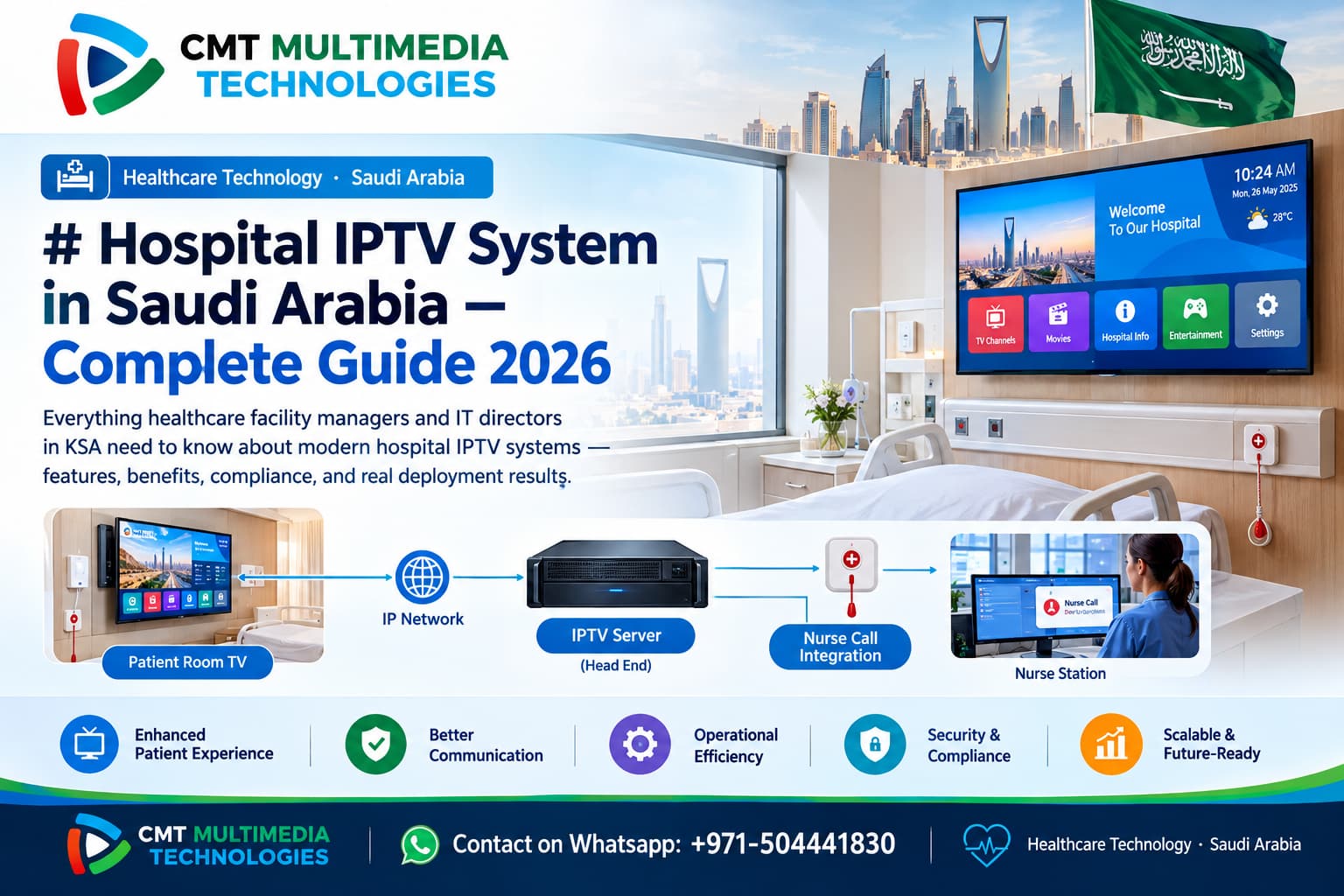
Hospital IPTV System in Saudi Arabia — Complete Guide 2026
📋 Guide Contents
What Is a Hospital IPTV System?
A hospital IPTV system distributes broadcast television channels, video-on-demand, targeted clinical education videos, and interactive health services over the facility’s existing local area network (LAN). By utilizing digital IP infrastructure rather than outdated coaxial cabling, the hospital gains centralized control over every screen installed across wards, private suites, waiting lounges, and ICU corridors.
This architectural design delivers distinct clinical and operational advantages. First, it eliminates the need for parallel wiring networks. Second, IT administrators can customize content per room, ward profile, or individual patient record. Third, the platform links natively with hospital information systems such as electronic medical records (EMR), nurse call stations, and campus-wide emergency signage. Complete bilingual Arabic and English support ensures domestic Saudi and international patients navigate their care plans effortlessly.
Why Saudi Arabia Hospitals Need IPTV Now
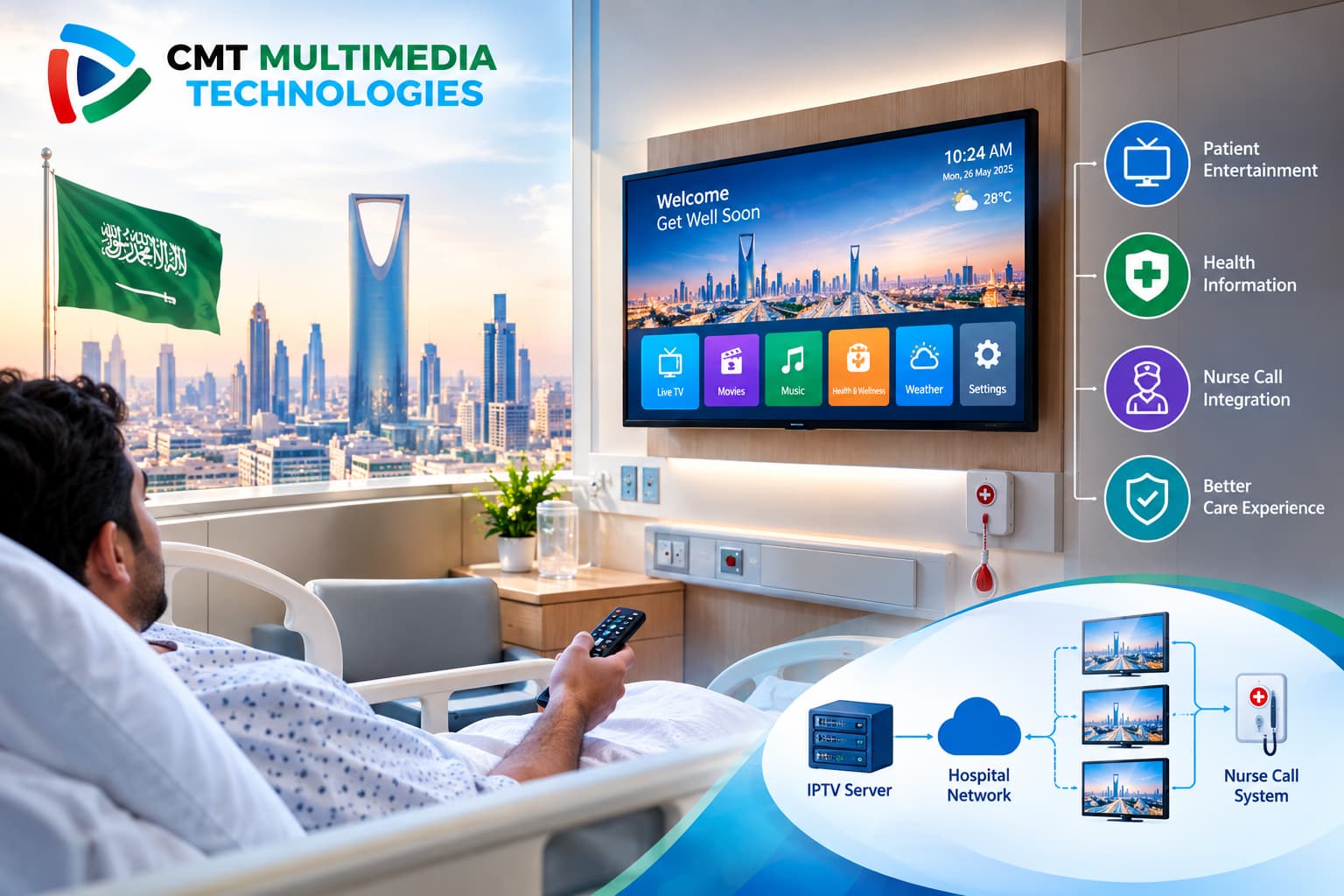
Saudi Arabia’s healthcare sector is undergoing its most comprehensive evolution in decades. Under Vision 2030 and the National Transformation Program, the Ministry of Health (MOH) prioritizes patient-centered care and digital infrastructure adoption. Formal hospital accreditation under CBAHI (Saudi Central Board for Accreditation of Healthcare Institutions) and international bodies like JCI increasingly measures patient experience alongside clinical outcomes.
Interactive bedside systems directly influence these metrics. Saudi patients have distinct cultural and religious expectations that standard commercial television cannot accommodate. These include dedicated Quran recitation channels, automated Adhan alerts calibrated to local prayer coordinates, Hijri calendar synchronization, and localized news networks like SBC and Al Arabiya. A customized platform like CMT’s patient communication system for hospitals in Riyadh satisfies these regulatory and cultural standards natively.
Key Features of a Modern Hospital IPTV System
An enterprise healthcare media deployment acts as a multifaceted clinical support hub at the patient bedside. Baseline capabilities include:
Native right-to-left navigation, high-definition Quran channels, automated prayer schedules, and Hijri calendar feeds on every screen.
High-definition live television broadcasts, licensed on-demand cinema, curated streaming apps, and family games accessible from bed.
Specialty-specific condition guides, medication instructions, and pre/post-operative educational videos available in Arabic and English.
Patients request clinical assistance, water, or room service via the pillow speaker or remote control, prioritizing critical alerts.
Direct bedside tele-health appointments with attending physicians and secure video conferencing with remote family members.
Corridor displays, clinic waiting area boards, and interactive wayfinding portals administered through a unified central console.
Full adherence to Saudi broadcast regulations enforced by the Communications, Space & Technology Commission (CST).
Biomedical and IT personnel monitor screen health, push firmware updates, and dispatch emergency alerts from one web console.
Measurable Benefits for Patients, Staff & Management
Deploying an interactive IP infotainment system delivers documented return on investment across clinical, technical, and executive operations:
| Hospital Stakeholder | Core Operational Benefit | Measured Clinical & Financial Impact |
|---|---|---|
| Inpatients & Families | Tailored bilingual education, entertainment, and religious media | Up to 30% higher satisfaction scores |
| Nursing Teams | Bedside routing of routine non-clinical service requests | 20–25% reduction in routine call bell volume |
| IT & Biomedical Dept | Central IP management across all displays with zero room visits | 60% decrease in television maintenance hours |
| Hospital Management | Automated broadcasting of safety standards, policies, and news | 40% faster campus-wide emergency notification |
| Quality Accreditation | Documented education viewing histories for inpatient audits | Directly satisfies CBAHI and JCI audit benchmarks |
How the System Is Deployed in Saudi Arabia Hospitals
CMT Technologies executes healthcare installations through a five-stage phased methodology engineered to guarantee zero disruption to active clinical environments:
Engineers evaluate server room rack space, network switch capabilities, existing displays, and clinical data VLAN isolation.
Configuration of the Arabic-first UI, verified Saudi channel lineups (SBC, MBC, Al Arabiya), prayer schedules, and educational libraries.
The head-end server is installed and tested first. Individual patient rooms are connected in 30–45 minutes without displacing patients.
Hands-on operational training delivered in Arabic and English for clinical nursing teams, patient relations, and hospital IT staff.
Following a two-week pilot phase, the system goes live backed by 24/7 remote monitoring and local field support across Saudi Arabia.
Hospitals We Have Served Across UAE & Saudi Arabia
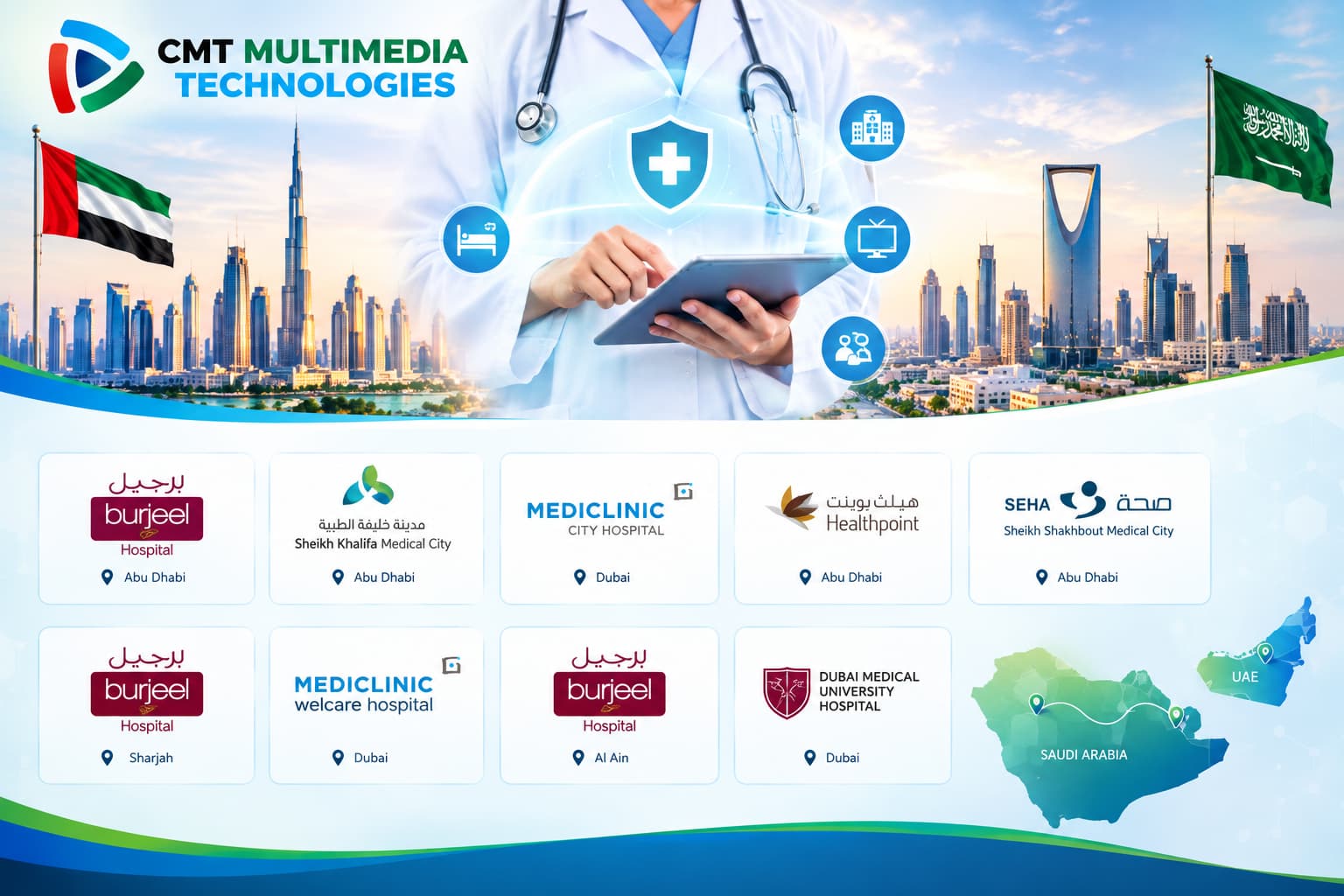
CMT Technologies has deployed managed healthcare and enterprise television infrastructure across prominent hospital networks in the GCC:
Furthermore, our engineering expertise extends into luxury hospitality across the GCC, powering brands like Fairmont, Marriott, Hyatt, and Four Seasons. Review our enterprise solutions for hospitality IPTV systems in Saudi Arabia and discover how five-star guest experiences elevate modern inpatient care.
Verified Healthcare Feedback
“The IPTV system transformed the patient experience across our wards. Patients can now access Arabic education videos and request nursing assistance directly from their TV. Our CBAHI scores for patient satisfaction improved significantly after deployment.”
Multi-Specialty Hospital — Abu Dhabi“What impressed us most was the Arabic-first approach. Prayer times, Quran channels, and the Hijri calendar were available from day one. The deployment team completed all 200 rooms in under two weeks with no disruption to patient care.”
Private Hospital Group — UAE“The 24/7 support from the CMT team is exceptional. Any technical query is resolved remotely within the hour. We haven’t experienced a single ward-wide outage since the system went live over 18 months ago.”
Medical City — GCCHospital IPTV vs Traditional Cable TV: Technical Matrix
| Operational Capability | CMT Hospital IPTV Platform | Traditional Cable / Coaxial TV |
|---|---|---|
| Arabic UI & Quran Channels | ✓ Native Right-to-Left Interface | ✗ Limited or None |
| Patient Education Library | ✓ Interactive, Ward-Specific VOD | ✗ Unavailable |
| Nurse Call & Bedside Ordering | ✓ Integrated on Bedside Screen | ✗ Separate Hardware Required |
| Ward-Level Content Administration | ✓ Centralized Web Console | ✗ Manual Room Tuning |
| Digital Signage Integration | ✓ Included on Common Network | ✗ Disconnected Systems & Costs |
| Cabling Infrastructure | ✓ Existing Hospital LAN (Ethernet/Fiber) | ✗ Heavy Coaxial Distribution |
| Regulatory Broadcast Compliance | ✓ Fully Authorized (CST / CITC) | ✗ Varies by Local Contractor |
| Ongoing Maintenance Costs | ✓ Low (Automated Remote NOC) | ✗ High (In-Person Room Service) |
Frequently Asked Questions: Hospital IPTV System Saudi Arabia
What is a hospital IPTV system and how does it work in Saudi Arabia?
A hospital IPTV system distributes high-definition television, patient education videos, automated prayer times, and nurse service requests over the hospital’s existing local IP data network. It replaces legacy coaxial cabling with a centrally managed, interactive healthcare communication portal.
Is hospital IPTV compliant with Saudi Arabia CST / CITC regulations?
Yes. Operating commercial video networks inside healthcare facilities requires adherence to broadcast frameworks enforced by the Communications, Space and Technology Commission (CST). CMT Technologies holds licensed commercial distribution agreements, ensuring full regulatory compliance.
How much does a hospital IPTV system cost in Saudi Arabia?
Total investment depends on room count, existing network switch readiness, smart TV hardware compatibility, and required clinical integrations (EMR or Nurse Call). Because IPTV utilizes existing hospital LAN cabling, it typically lowers long-term capital and maintenance expenses compared to legacy coaxial networks.
Can the platform display Quran channels and automated prayer notifications?
Yes. The system incorporates precision prayer schedules calculated for Riyadh, Jeddah, Makkah, or Dammam coordinates, alongside dedicated high-definition audio and video Quran channels and live Makkah/Madinah satellite feeds.
How long does installation take without disrupting clinical care?
Deployments follow a phased ward-by-ward schedule. Head-end servers are configured first off-peak, after which patient rooms take 30 to 45 minutes each. Patient care proceeds without interruption throughout rollout.
Does the system integrate with hospital EMR and nurse call infrastructure?
Yes. Our middleware connects with hospital information systems and standard nurse call platforms via HL7 and secure REST APIs, enabling automated patient welcome messages and non-urgent service routing.
Which cities across Saudi Arabia does CMT Technologies support?
We provide turnkey engineering, installation, and field service across Riyadh, Jeddah, Makkah, Madinah, Dammam, Khobar, and secondary healthcare clusters throughout the Kingdom.
What ongoing technical support is included post go-live?
CMT provides 24/7 system monitoring via our regional Network Operations Center, automated software updates, and dedicated on-ground field engineering support across Saudi Arabia.
Upgrade Your Healthcare Facility’s Bedside Experience
Connect with our healthcare technology engineers to schedule a complete network readiness evaluation and custom platform demonstration.
Request a Free Consultation →