

How Does OTT Work — Complete Beginner Guide 2026
Understanding how does OTT work is essential for anyone building or evaluating a modern streaming strategy. In simple terms, OTT, short for Over the Top, delivers video directly over the internet instead of through cable, satellite, or a managed broadcast network. Specifically, your video gets compressed, broken into small chunks, sent through servers around the world, and then reassembled on your screen, with quality adjusting automatically to match your connection speed. This guide walks through each stage of that OTT streaming pipeline in plain language. For a deeper technical comparison, see our IPTV and OTT solutions page, and for a real-world deployment example, read how CMT built the SBC national OTT platform in Saudi Arabia.
What OTT Streaming Actually Means
OTT stands for Over the Top, a term that describes any service delivering video content directly over the public internet, bypassing the cable or satellite company entirely. When cable television was first built, the cable provider owned every part of the chain: the wires, the set-top box, the broadcast rights, and the customer relationship. However, OTT flips that model entirely. A content provider uses internet infrastructure they do not own to reach viewers directly and that is the real meaning of going “over the top” of traditional gatekeepers.
By 2026, OTT streaming has matured well beyond its original definition as a Netflix alternative. Indeed, streaming now accounts for the majority of total television viewing time worldwide, according to Nielsen’s The Gauge report. Moreover, the same underlying OTT technology now powers entertainment platforms, enterprise training systems, telehealth, live sports, and hotel guest entertainment networks alike.
OTT streaming delivers video over the public internet rather than cable or satellite. The technology stack combines encoding, adaptive bitrate streaming, CDN delivery, DRM security, and a middleware layer that ties it all together.
The Five Stages of How OTT Works
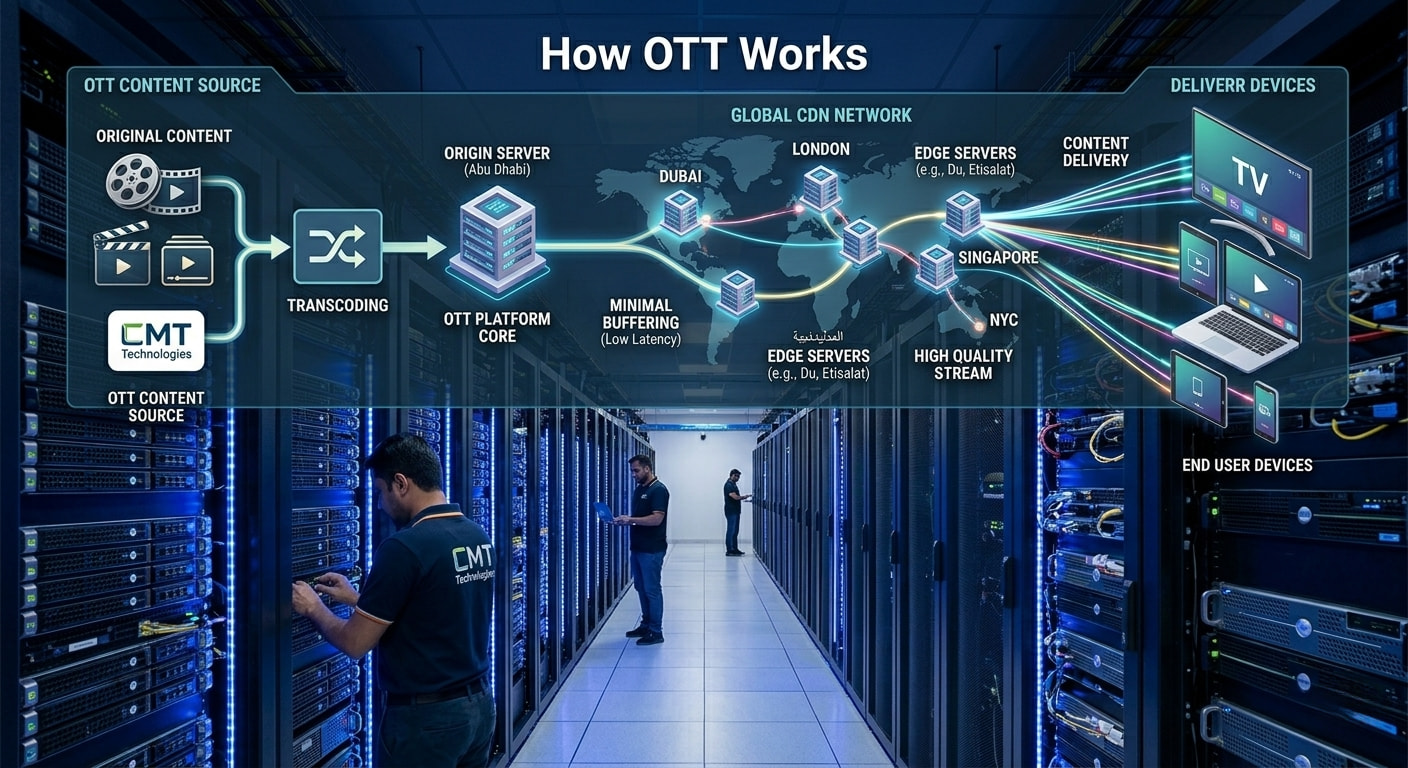
Every OTT platform — from a global streaming giant to an enterprise hotel network, follows the same five-stage pipeline to get a video from source to screen. Understanding how OTT works at each stage helps you make better decisions when selecting or building a platform.
Content Ingest
The raw video, whether a live camera feed or a pre-recorded file, enters the system through a standard protocol and is prepared for processing.
Encoding and Transcoding
Next, the video is compressed and converted into multiple quality versions, from low resolution for weak connections up to high definition for fast ones.
Packaging for Delivery
The encoded video is then chopped into small chunks and packaged using a streaming protocol, most commonly HLS or DASH, so players can request pieces as needed.
CDN Distribution
After packaging, a content delivery network copies the video chunks to servers positioned close to viewers around the world, reducing buffering and load times.
Playback on Any Device
Finally, the viewer’s device — a phone, smart TV, or laptop — requests the nearest chunk and plays it, automatically switching quality if the connection changes.
How OTT Streaming Uses Adaptive Bitrate
Adaptive bitrate streaming is the primary reason video rarely stops to buffer on a modern OTT platform. Rather than sending one fixed-quality stream, the encoder prepares several versions of the same video at different resolutions and bitrates. As a result, the player on your device constantly measures your connection speed and switches between these versions automatically. Furthermore, it drops quality briefly during a weak signal and restores it once the connection improves, all without ever interrupting playback. This adaptive approach is what makes OTT streaming reliable across widely varying network conditions, from gigabit home broadband to a mobile connection on a moving train.
Core Components of an OTT Streaming Platform
Compresses raw video into multiple bitrate versions ready for OTT streaming.
Distributes video chunks globally so viewers connect to the nearest server.
Encrypts content so only authorised, paying viewers can play it back.
Manages user accounts, subscriptions, recommendations, and analytics.
OTT vs IPTV: Key Differences in OTT Streaming Delivery
People often use OTT and IPTV interchangeably; however, the underlying delivery method is quite different. OTT streaming travels over the public, open internet to reach any device, anywhere in the world. IPTV, by contrast, travels over a private, managed network that the service provider controls end to end. Consequently, IPTV typically delivers more predictable quality, but it requires that specific network infrastructure to be installed beforehand. For more technical context on these protocols, the ITU-T H.264 standard and IETF RFC 8216 for HLS are the foundational specifications behind both delivery methods.
| Factor | OTT Streaming | IPTV |
|---|---|---|
| Network | Public internet | Private, managed network |
| Device reach | Any internet-connected device | Devices on the managed network |
| Quality control | Depends on viewer’s connection | Controlled end to end by provider |
| Typical use case | Consumer streaming apps, global reach | Hotels, hospitals, telecom operators |
| Setup | App download, internet connection | Provider-managed installation |
How Businesses Deploy OTT Streaming Infrastructure
OTT streaming technology is no longer limited to entertainment. CMT Technologies builds enterprise OTT platforms for telecoms, broadcasters, hotels, and hospitals across the GCC, applying the same five-stage pipeline described above at full production scale. For instance, the Mobily MView platform serves over 200,000 subscribers using this exact OTT streaming architecture. Similarly, the SBC national broadcasting OTT solution in Saudi Arabia delivers nine HD channels and six radio channels using the same encoding, packaging, and CDN principles.
In addition, industries such as telehealth, education, and corporate training are increasingly adopting OTT streaming to reach distributed audiences securely and at scale. To understand how these deployments are structured in practice, see our detailed Mobily MView case study.
Understanding how OTT works is the first step. Building an OTT streaming platform that handles thousands of concurrent viewers reliably is a different challenge entirely — one that requires encoding infrastructure, CDN partnerships, and DRM licensing that most businesses do not build alone.
Why CMT Technologies for Your OTT Platform
CMT Technologies has delivered enterprise IPTV and OTT streaming infrastructure across the GCC since 2009, including telecom-scale OTT platforms, national broadcaster deployments, and hospitality streaming systems. Furthermore, our in-house middleware means custom features are built fast, not outsourced to a third-party vendor. As a result, clients avoid the delays and licensing costs that typically come with external middleware dependencies.
- ✓OTT streaming delivers video over the public internet, bypassing cable and satellite entirely
- ✓The OTT pipeline has five stages: ingest, encode, package, distribute via CDN, and play
- ✓Adaptive bitrate streaming keeps OTT playback smooth by adjusting quality automatically
- ✓OTT and IPTV differ mainly in network type: public internet versus managed network
- ✓CMT Technologies builds enterprise OTT streaming platforms at telecom and national broadcaster scale
Frequently Asked Questions: How Does OTT Work?
OTT works by compressing video into small chunks, sending those chunks through global servers called a CDN, and delivering them to your device over the internet. The video quality then adjusts automatically based on your connection speed, a process called adaptive bitrate streaming.
OTT delivers content over the public internet to any device, while IPTV delivers content over a managed, private network controlled by a telecom or service provider. IPTV typically offers more predictable quality because the network is controlled end to end, whereas OTT relies on the public internet.
OTT streaming platforms combine video encoding, adaptive bitrate streaming using HLS or DASH protocols, content delivery networks, DRM for content protection, and a middleware layer that manages user accounts, playback, and analytics.
Yes. CMT Technologies builds enterprise OTT streaming platforms for telecoms, broadcasters, hotels, and hospitals across the GCC, including the Mobily MView platform serving 200,000 plus subscribers and the SBC national broadcasting OTT solution in Saudi Arabia.
Build Your Enterprise OTT Platform
CMT Technologies designs and deploys OTT streaming infrastructure for telecoms, broadcasters, and hospitality groups across the GCC.