

Guest Casting Wrong Room in Hotels
Guest Casting Wrong Room: Why It Happens in Hotels
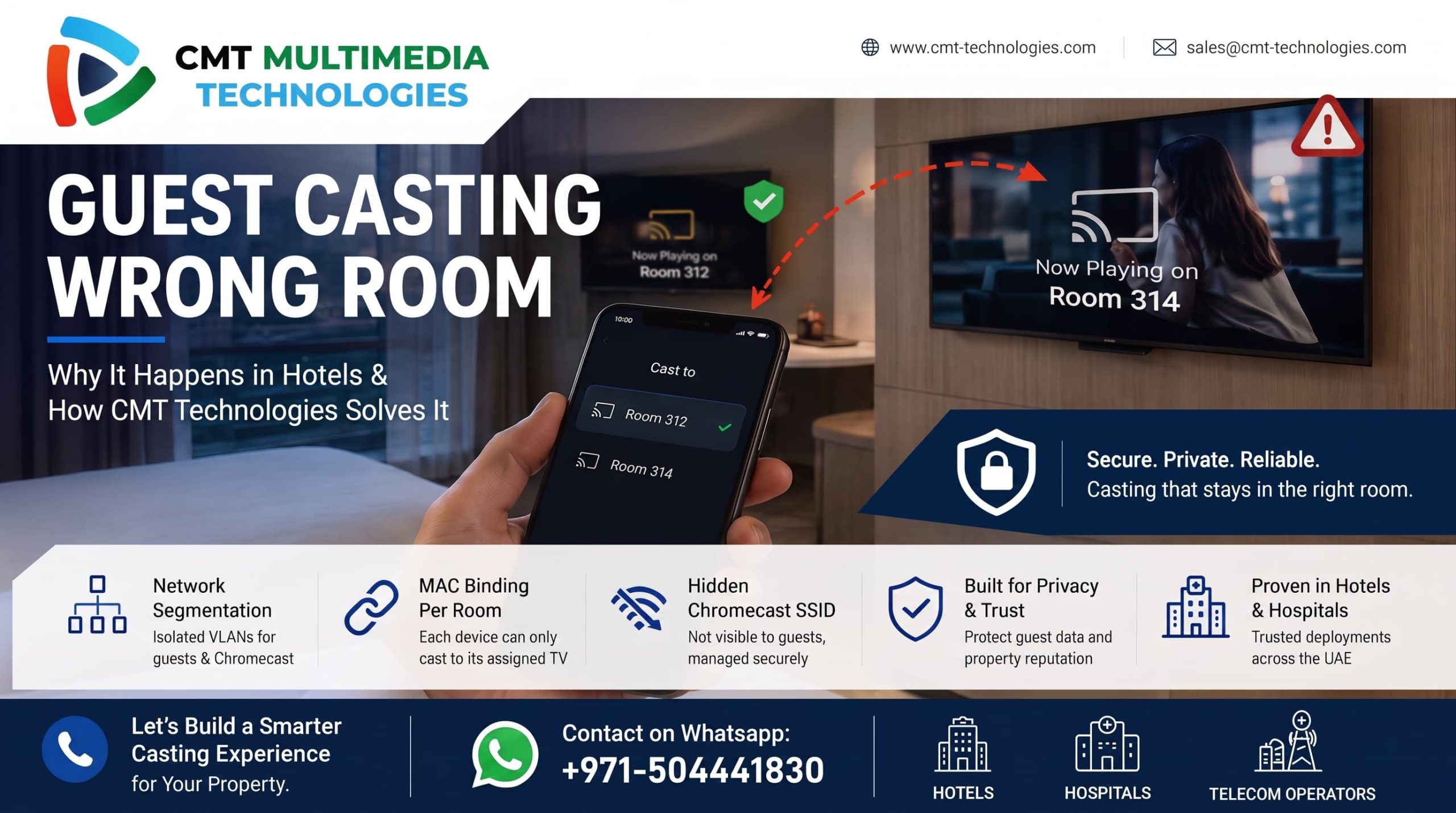
A guest opens Netflix on their phone. They tap cast. Suddenly, their show appears on a stranger’s TV two rooms away. This is a classic case of guest casting wrong room, and it is not a rare glitch. In fact, it is a common problem in hotels and hospitals with open WiFi networks. Guests expect privacy. Instead, they often get confused screens and awkward surprises.
CMT Technologies studies this exact failure point closely. So, this blog explains why guest casting to the wrong room happens. It also explains how proper network design prevents it entirely.
What Does Guest Casting Wrong Room Actually Mean?
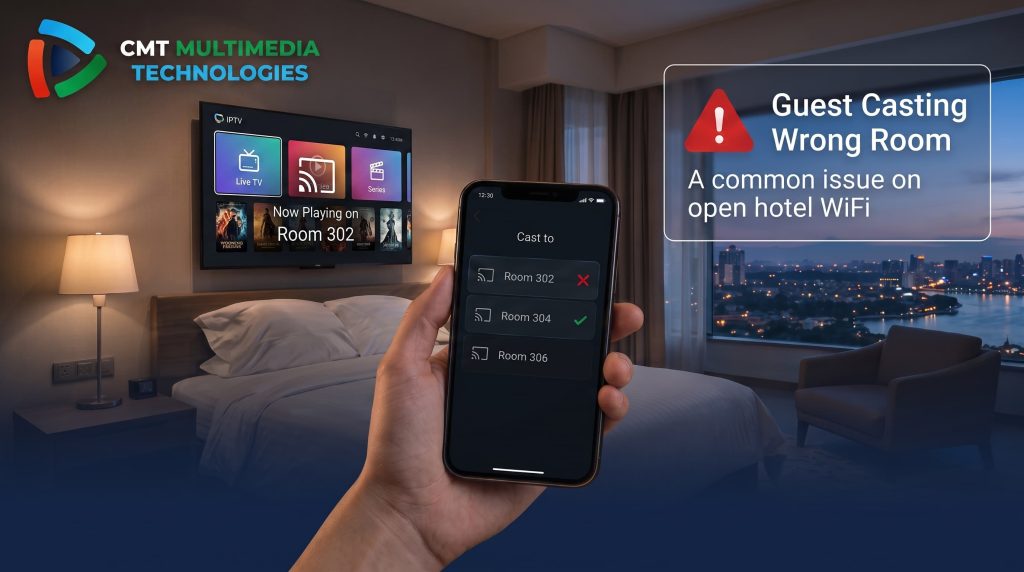
Chromecast devices are designed to find each other automatically. This works well at home. However, it becomes a problem in shared environments like hotels.
When many devices share one network, they can all see each other. For example, a phone in Room 12 may detect a TV in Room 14. That connection should never be possible.
How Chromecast Finds Nearby Devices
Chromecast uses a discovery method called mDNS, a protocol also documented in Google’s Cast developer guide. It broadcasts a signal on the local network. Any device listening on that same network can respond.
This is how casting works without typing in an IP address. It is fast and convenient. But it also assumes every device on the network is trusted.
Why This Works Fine at Home, Not in Hotels
At home, one household shares one network. Everyone in that home is a trusted user. As a result, discovery between devices is expected and safe.
A hotel, however, is different. Dozens of strangers share the same WiFi. Each guest still expects their casting session to stay private. So, standard Chromecast behavior does not account for this.
Why Standard Hotel WiFi Causes Guest Casting Wrong Room Issues
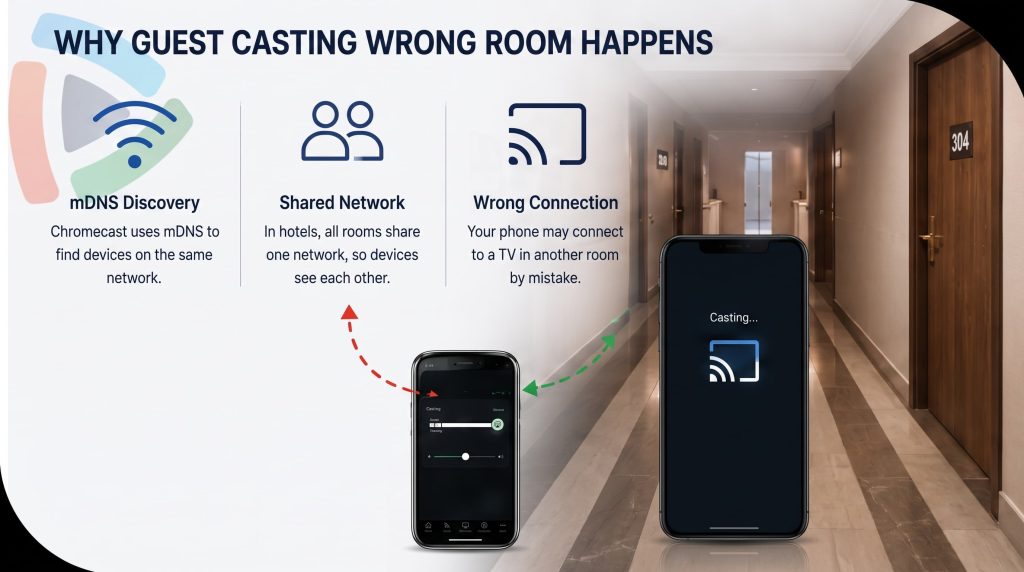
Most hotel WiFi networks are built as one flat network. Because of this, every guest, every room, and every TV connects to the same broadcast domain.
This setup is simple to install. Yet it is also the root cause of wrong-room casting. Nothing separates one guest’s devices from another’s.
The Flat Network Problem
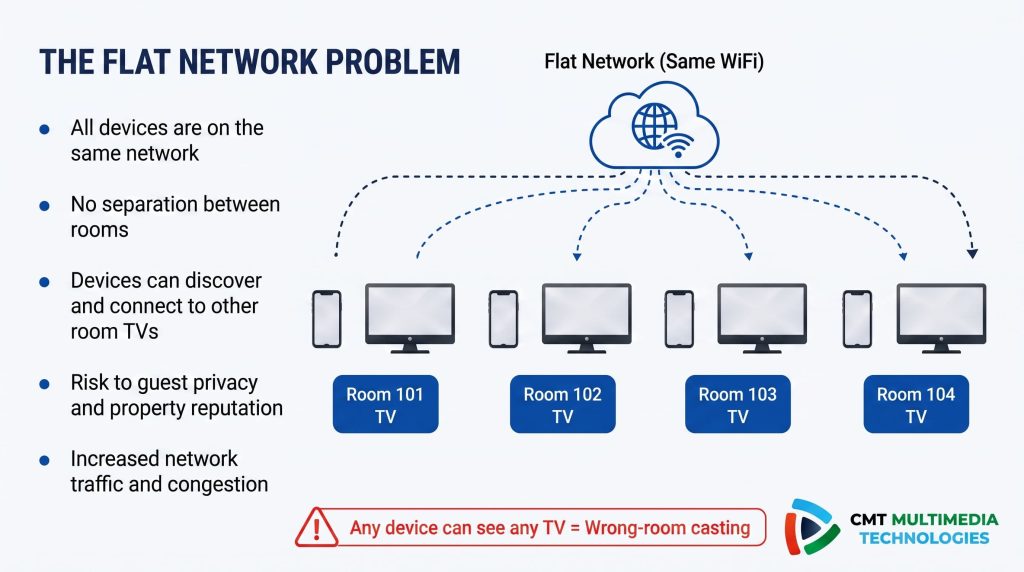
A flat network treats every connected device as equal. There is no wall between Room 3 and Room 30. Therefore, any device can technically discover any other device.
This is fine for basic internet browsing. However, it fails completely for casting apps like YouTube or Disney+, screen sharing, and smart TV pairing.
Real Risk for Guests and Properties
Guests lose trust fast when private screens turn up in unexpected places. For instance, a stranger’s photos or streaming history appearing on a TV feels invasive.
For hotels, this creates real reputation risk. Guests often share bad experiences online quickly. For hospitals, the stakes are even higher, since patient privacy is not optional.
How CMT Technologies Prevents Guest Casting Wrong Room
CMT Technologies designs Chromecast deployments to prevent this problem entirely. Specifically, the solution separates guest traffic from Chromecast traffic at the network level.
This is not a simple workaround. Instead, CMT builds it into the network architecture from day one.
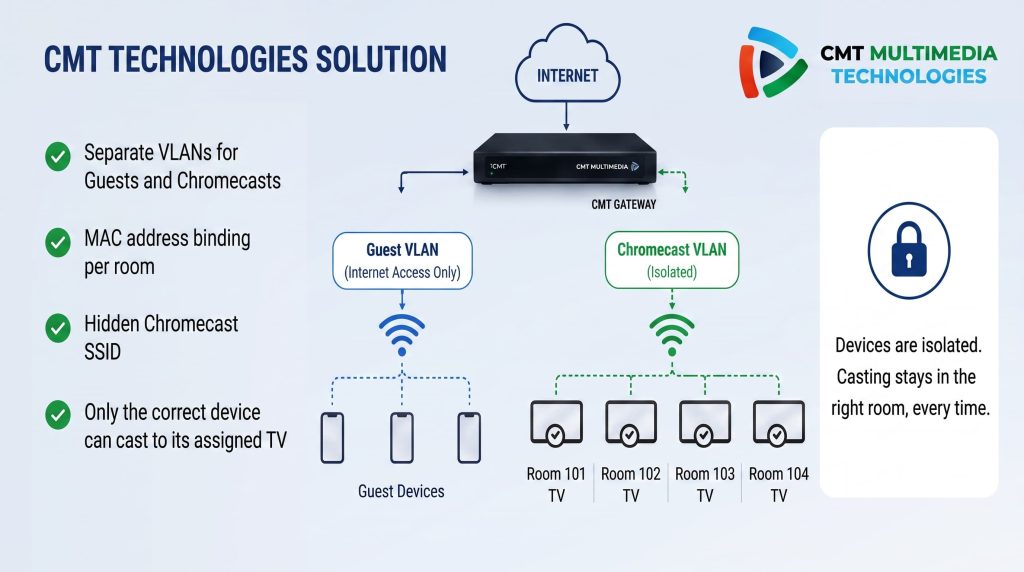
Separate VLANs for Guests and Chromecasts
CMT’s Chromecast Solution uses two separate VLANs. One VLAN handles all guest devices. Meanwhile, a second VLAN handles all Chromecast hardware.
These VLANs do not freely communicate with each other. As a result, this alone blocks most accidental cross-room discovery.
MAC Address Binding Per Room
The system matches every guest device to one specific TV. It identifies each device by its MAC address, a unique hardware identifier.
Once matched, that phone can only cast to its assigned TV. It cannot see or connect to any other screen in the building.
Hidden Chromecast SSID
The Chromecast network itself stays hidden from public view. Guests never see it or connect to it directly.
Consequently, this reduces the chance of accidental or unauthorized casting attempts. The gateway server manages this connection behind the scenes. For hotels, this means guests get a private, predictable casting experience every time. There is no confusion and no awkward moments. Guests see only their own content, on their own screen..
What This Means for Hotels and Hospitals
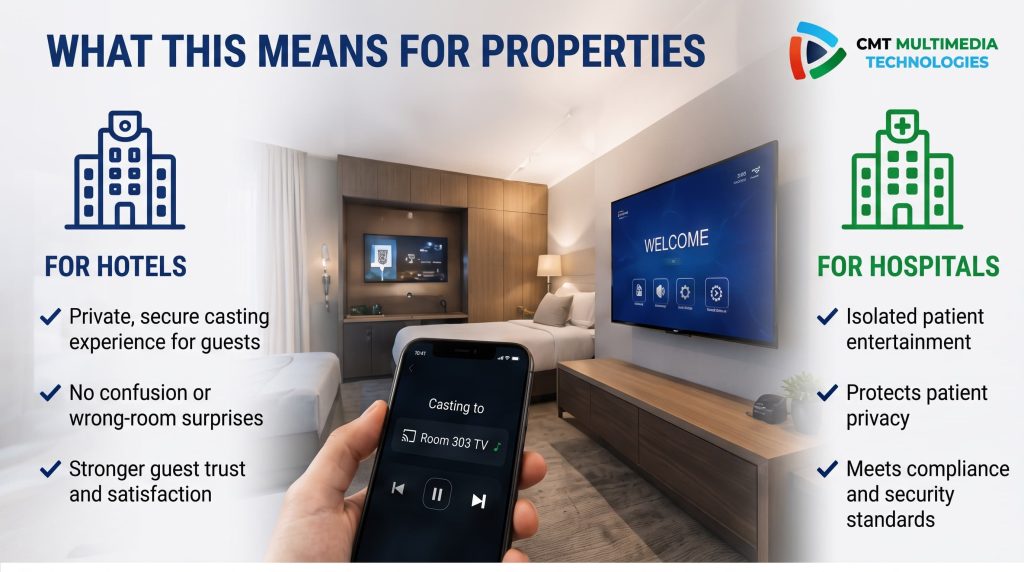
For hotels, this means guests get a private, predictable casting experience every time. So, there is no confusion and no awkward moments. Just their content, on their screen.
For hospitals, this matters even more. Patient rooms need strict privacy. In fact, CMT’s deployment for Mediclinic Parkview Hospital shows this in practice. Each patient room stays fully isolated from every other room on the network.
Guest Casting Wrong Room: Key Takeaways
- Open networks let devices discover each other by default
- Flat WiFi architecture is the root cause of wrong-room casting
- VLAN segmentation and MAC binding fix this at the network level
- CMT Technologies builds this protection directly into its Chromecast Solution
Final Thoughts
Guest casting wrong room is not a small annoyance. It is a network design flaw. Ultimately, properties that ignore it risk guest trust and, in healthcare settings, patient privacy.
CMT Technologies solves this at the infrastructure level, not with a patch or app setting. Therefore, see how CMT Technologies’ Chromecast Solution prevents this from ever happening in your property.
Connect with CMT Technologies
Contact us via our website to schedule your personalized demonstration.