

External Digital Signage in Jeddah 2027
External Digital Signage in Jeddah 2027
Weatherproof outdoor screens for transport hubs, building facades, wayfinding and retail, designed, installed and supported by CMT Technologies across Jeddah.
Transport hubs
Building facades
Wayfinding totems
Drive-through screens
External digital signage in Jeddah means outdoor screens that keep working in summer heat, dust and humid sea air. CMT Technologies designs, installs and supports weatherproof outdoor displays for transport hubs, building facades, wayfinding totems and retail across Jeddah, as one service, since 2009, across Saudi Arabia, the UAE, Qatar, Kuwait and Bahrain. Explore our digital signage solutions, see external digital signage in Riyadh for our Riyadh guide, or request a demo. CMT Technologies is also an IPTV supplier in the UAE, so one team can look after your screens and your TV systems.
What external digital signage covers
Transport hubs
King Abdulaziz International Airport, Jeddah's bus stations and transport hubs. Screens show directions, timetables and service updates where thousands of people pass every day.
Building facades
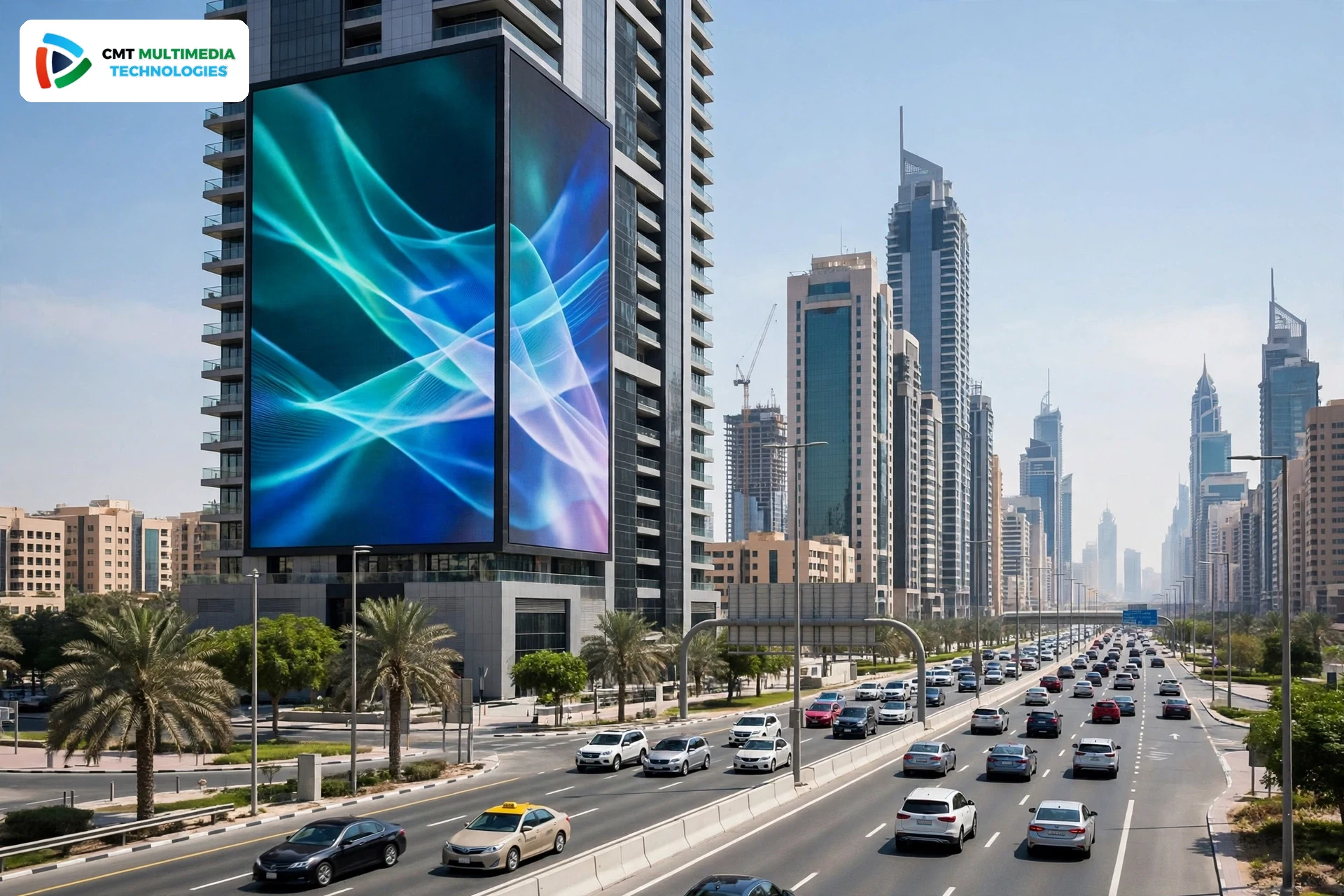
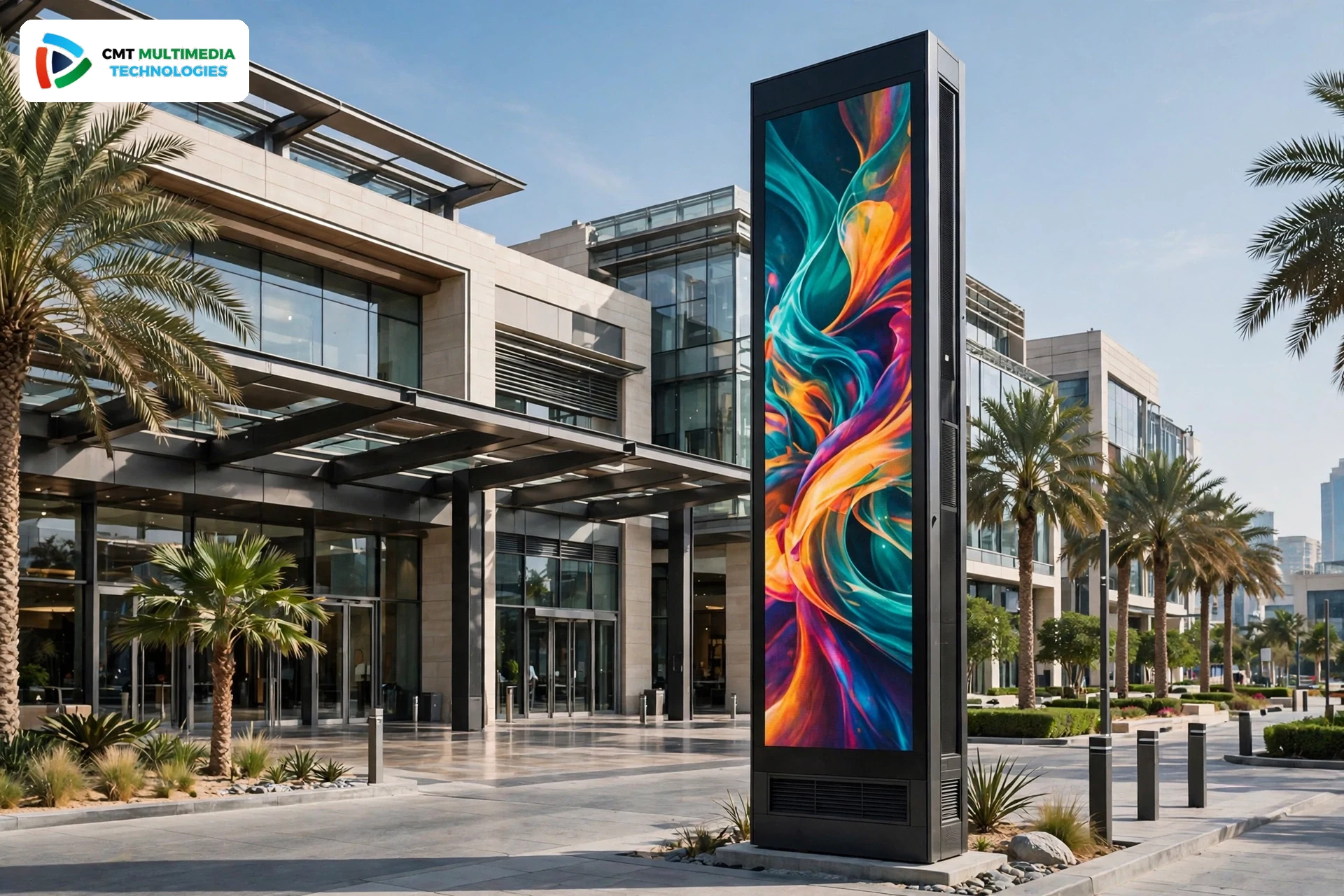
Large format LED screens on building fronts along King Abdulaziz Road and in business districts such as Jeddah's Corniche and business areas, visible from far away, day and night.
Wayfinding totems
Freestanding outdoor totems at malls, districts and public spaces that guide visitors to shops, offices and parking.
Drive-through screens
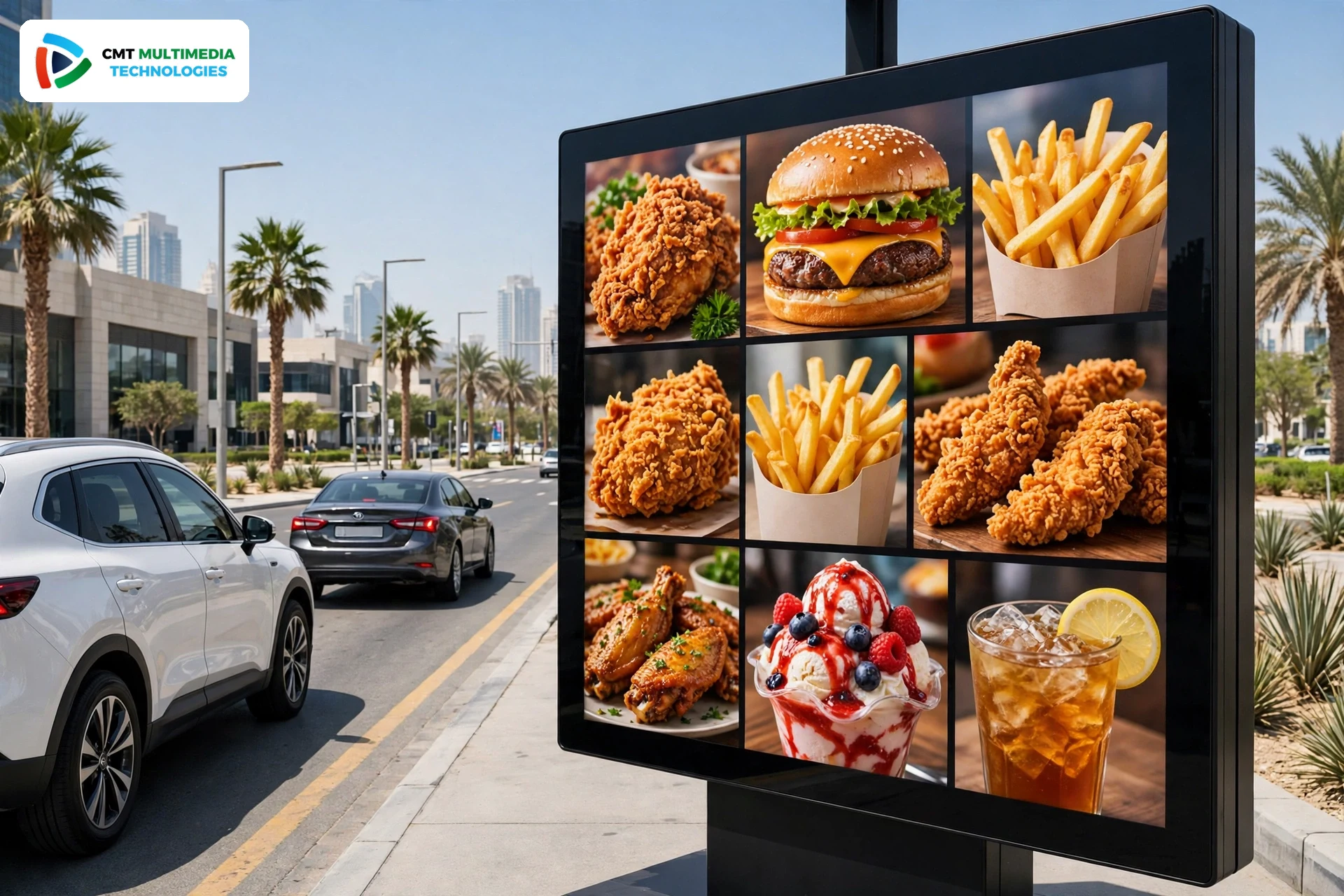
Outdoor menu boards and order screens at drive-through restaurants, bright enough to read in direct sunlight.
What is external digital signage?
External digital signage is a screen built for the outdoors. It shows information, advertising or messages on a bright display that is protected from heat, dust, rain and direct sunlight, and it is updated from a computer or a cloud dashboard, the same way indoor signage is managed. Instead of printing a new poster for every promotion, the content changes on a screen in minutes, across one site or every site in a network.
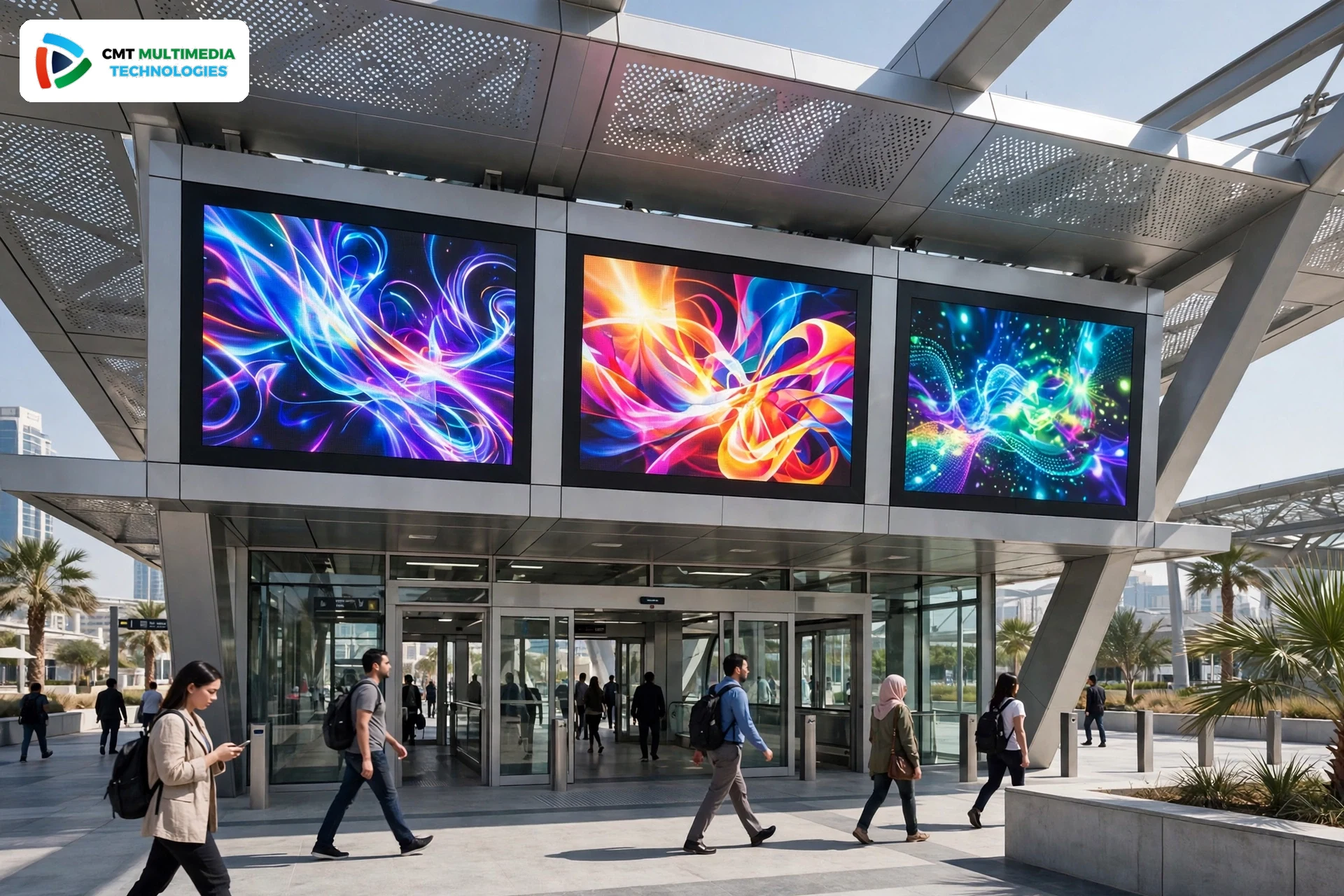
A screen that works indoors will not survive outdoors in Jeddah. An outdoor screen needs a brighter panel, a sealed enclosure that keeps dust and moisture out, cooling that handles summer heat, and a mount that holds it steady in wind. That is the difference between a domestic television and an outdoor digital signage display.
Outdoor screens built for Jeddah's climate
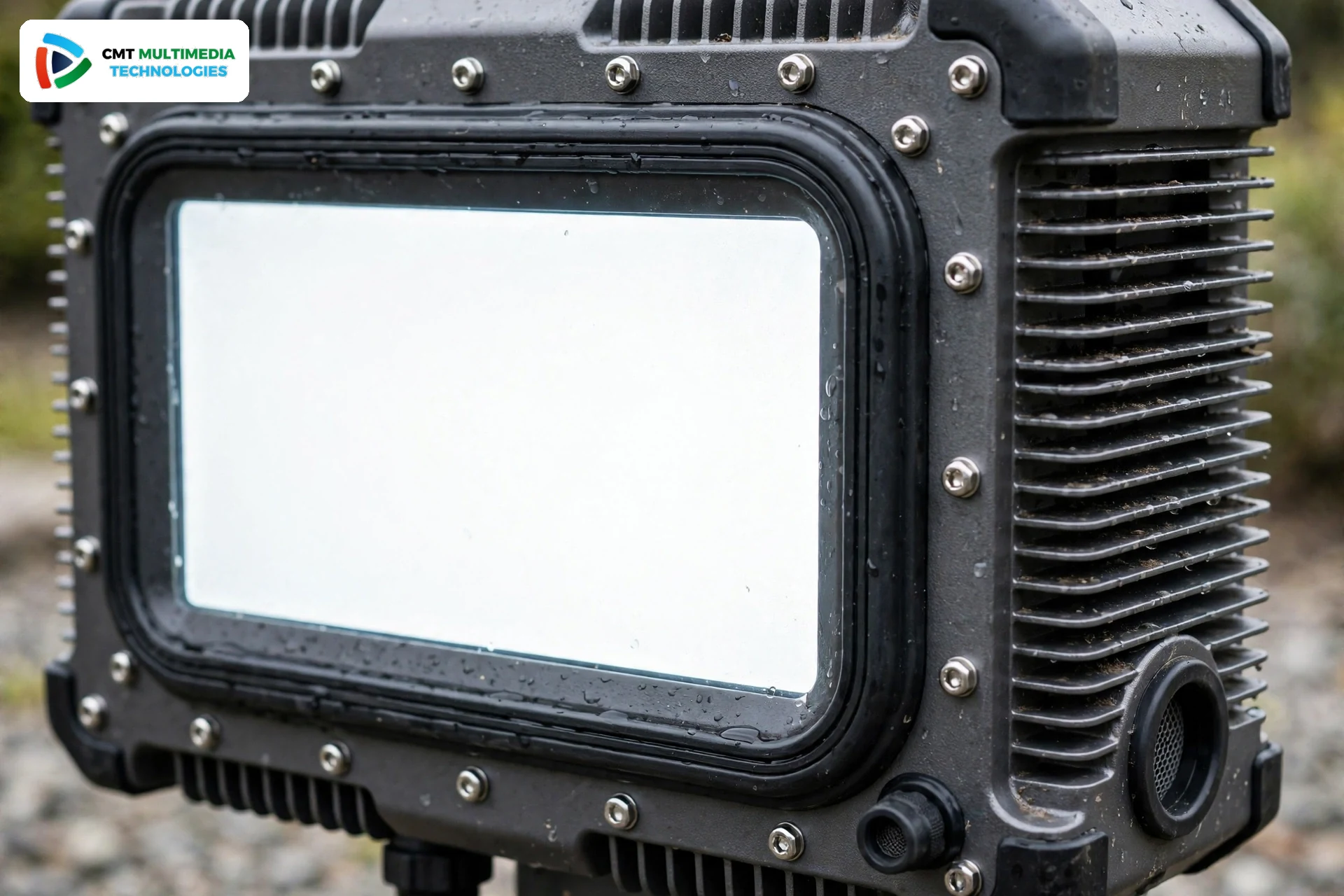
Jeddah summers are hot and humid, with direct sun, dust and sea air. Temperatures reach the high 40s, and humidity is high near the Red Sea coast. Those conditions change how a screen should be chosen, enclosed, cooled and maintained. A screen that works well indoors in a mall will not survive on a building facade.
Heat builds up inside an enclosure, so outdoor screens need cooling and a sealed enclosure that keeps dust and moisture out. Direct sun washes out an ordinary screen, so outdoor screens use high brightness. Dust, humidity and sea air mean the enclosure, the seals and the mounts need regular checks and cleaning, and sandstorms make that maintenance more important, not less.
That is why indoor screens fail outdoors within months. They are not built for heat, sun, dust or rain, their brightness is too low for sunlight, and they have no sealed enclosure or cooling. Choosing an outdoor display, a sealed enclosure and a support plan that includes cleaning and checks is what keeps a Jeddah screen working.
Where outdoor signage is used in Jeddah
Outdoor digital signage in Jeddah is used where people move, wait and look up. Transport hubs use it for directions and live service information. Building facades use it for branding and advertising that is visible from the road. Malls use totems and exterior screens to guide visitors and promote offers. Drive-through restaurants use outdoor menu boards that stay readable in sunlight. Retail flagships use large outdoor displays to draw shoppers in from the street.
For transport hubs, screens work alongside wayfinding totems and indoor displays, so a traveller sees the same message at every step. For facades, the screen must be bright enough for a driver to read it, and the content must be short. Our smart communities solutions use the same thinking for public spaces.
Large-format facades on King Abdulaziz Road
A facade screen is the largest outdoor format in Jeddah. It turns a building front into a landmark that thousands of drivers and pedestrians see every day. A facade installation needs a structural survey, a panel system built for the building, and a content plan that works at road distance, where the message must be read in a few seconds. Large outdoor digital signage is the right choice when the goal is visibility at scale, not detail up close.
Outdoor LED vs Outdoor LCD
| Type | Brightness | Enclosure | Best for |
|---|---|---|---|
| Outdoor LED | Very high, readable in direct sunlight | Sealed, weatherproof, with cooling | Building facades, large outdoor displays, roadside |
| Outdoor LCD | High, readable in sunlight | Sealed, weatherproof, with cooling | Transport hubs, wayfinding totems, drive-through menu boards |
| Facade LED | Very high, built for large format | Structural mount, weatherproof | King Abdulaziz Road facades, large-format advertising |
Both use high brightness panels and sealed enclosures. The difference is scale. LED suits very large screens and facades, where the picture is read from far away. LCD suits smaller outdoor screens where fine detail matters up close, such as a menu board or a wayfinding totem.
What CMT Technologies provides, end to end
CMT Technologies provides outdoor digital signage end to end, from the first site survey to installation, training and support.
- Consultation and site survey. We visit the site, understand what the screens need to do, and check the space, the power and the network.
- Design and specification. We design the screen layout and specify the right display, enclosure and mount for each location.
- Screens and enclosures. We supply commercial displays and media players, built for long hours in public places.
- CMS and content setup. We set up the content management system, the screen layouts and the first content, so the screens are ready to use.
- Installation. Our teams install the screens, the mounts and the cabling, and test every screen before handover.
- Training, support and AMC. We train your team, and support the system afterwards, including an annual maintenance contract.
A single screen usually takes about a day to install. A multi-site rollout is phased, so each site is installed and tested in turn, with minimal disruption to your business.
How much does external digital signage cost in Jeddah?
The cost depends on the size and number of screens, whether they are LED or LCD, the enclosure and cooling, the mounts and cabling, and the support you need. A single outdoor screen costs far less than a facade installation or a multi-site network, because there is more hardware, more installation and more content to manage.
What a quote includes
- Screen, the commercial display
- Enclosure, the sealed weatherproof housing
- Player, the media player
- Mount, wall, pole or structural mount
- Cabling, power and network cabling
- Network, connection to the content management system
- CMS licence, the content management system licence
- Installation, delivery, installation and testing
- Training, training for your team
- AMC, annual maintenance contract and ongoing support
7 questions to ask any outdoor signage provider
- Is the screen a commercial display, or a domestic television?
- Is it bright enough for the place it will be used, especially outdoors or in sunlight?
- Is the enclosure sealed against dust and moisture, with cooling if it is outdoors?
- Can I update every screen from one dashboard, across all my sites and countries?
- What does the quote include, screen, enclosure, player, mount, cabling, network, CMS licence, installation, training and AMC?
- How long does installation take, and how is a multi-site rollout phased?
- Who supports the screens afterwards, and what does the annual maintenance contract cover?
Why CMT Technologies
CMT Technologies was founded in 2009, and has more than 18 years of experience across the Gulf. One team designs, installs and supports outdoor digital signage across Saudi Arabia, the UAE, Qatar, Kuwait and Bahrain, with local teams in each country, one content management system and one support agreement. We use commercial displays, not domestic televisions, and we specify the right screen, enclosure and mount for the place it will be used. See how the same approach works in Dubai in our guide to external digital signage in Dubai.
By Abdul Wahab
Our Technology Partners








Case Studies
Our Solutions
Frequently Asked Questions
Yes, when they are built for it. An outdoor screen uses a high brightness panel inside a sealed, weatherproof enclosure with cooling, so it keeps working in summer heat, dust, humidity and sea air. An indoor screen will fail outdoors within months, because it has no sealed enclosure or cooling and its brightness is too low for sunlight.
Bright enough to read in direct sunlight. Outdoor screens use high brightness panels that stay clear in daylight, where an ordinary screen washes out. The exact brightness depends on where the screen faces and how much direct sun it gets.
It is a sealed housing that protects the screen from dust, rain and moisture, with cooling that handles heat. It keeps the display working outdoors all year, and it needs regular checks and cleaning.
A single screen usually takes about a day to install. A multi-site rollout is phased, so each site is installed and tested in turn, with minimal disruption to your business.
Yes. One dashboard manages every screen, across all your sites and countries, from one place.
CMT MULTIMEDIA TECHNOLOGIES
See it outdoors in Jeddah
See your content on weatherproof outdoor screens, at a transport hub, on a facade, or at your mall entrance. One demo, and you will know exactly how it will look in your space.
Email: sales@cmt-technologies.com | WhatsApp: +971-504441830
No Comments