

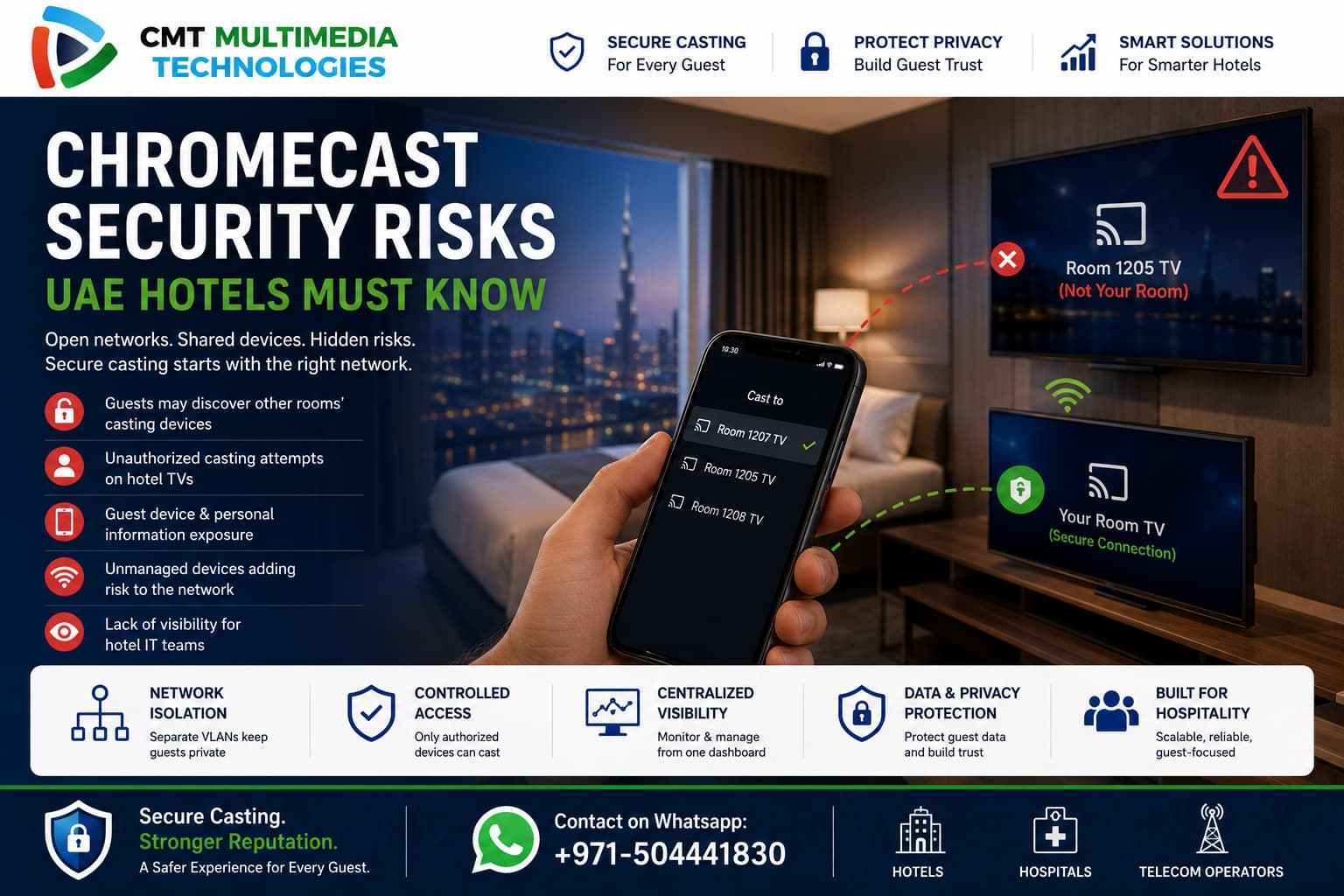
Chromecast Security Risks UAE Hotels Must Know
A guest checks into a hotel in Dubai. They connect their phone and cast a movie to the TV. It works instantly, and it feels effortless.
However, behind that simple action, the hotel’s network is doing a lot of work. If that network is not properly isolated, real security gaps can appear, including guest casting wrong room in hotel setups. Chromecast itself improves the guest experience. But poor network design is what actually creates risk.
So, the problem is not Chromecast. Instead, it is how the hotel configures and manages the network around it. This blog explains the main chromecast security risks, why guest casting wrong room in hotel networks happens, and how properties can reduce them.
Is Chromecast Actually a Security Risk for Hotels?
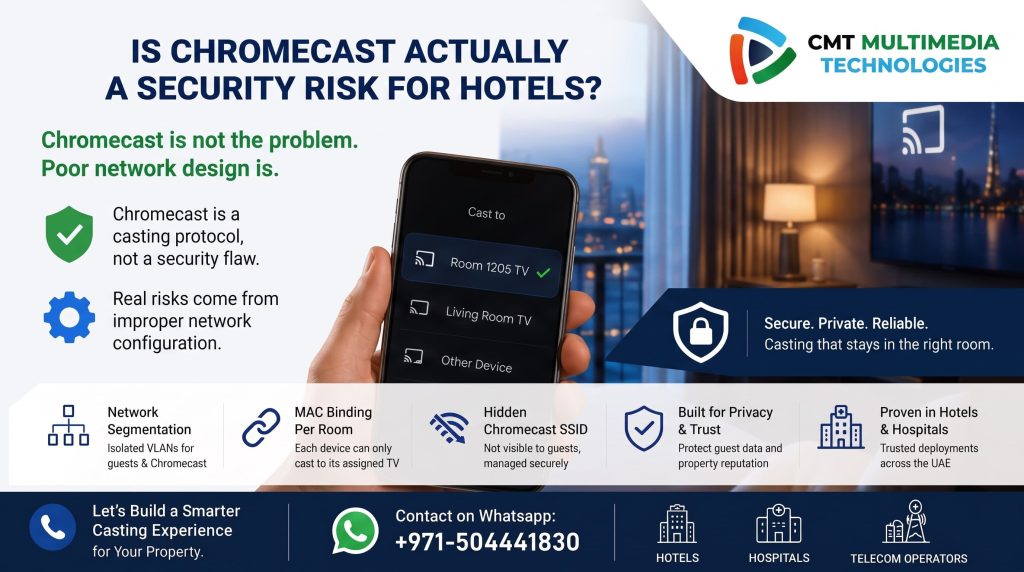
Many hotel teams assume Chromecast itself is unsafe. In fact, that is a common misconception. Chromecast is simply a casting protocol, not a security flaw.
Instead, the real chromecast security risks usually come from improper network configuration. Weak device isolation and missing access controls are the actual causes. Therefore, guest casting should run inside a controlled hospitality network, not an ordinary shared WiFi setup.
The Difference Between Guest Casting and an Open Network
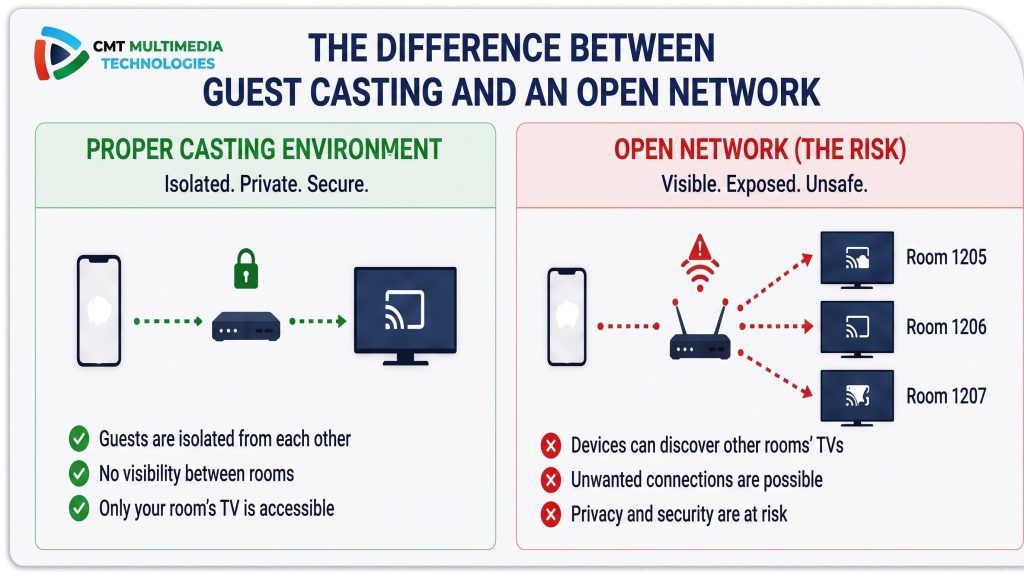
A properly designed casting environment separates guests from one another. As a result, no guest device can see or reach another guest’s screen.
An open network works differently. Because it is flat, devices may discover services they should never access. This gap is where most chromecast security risks begin.
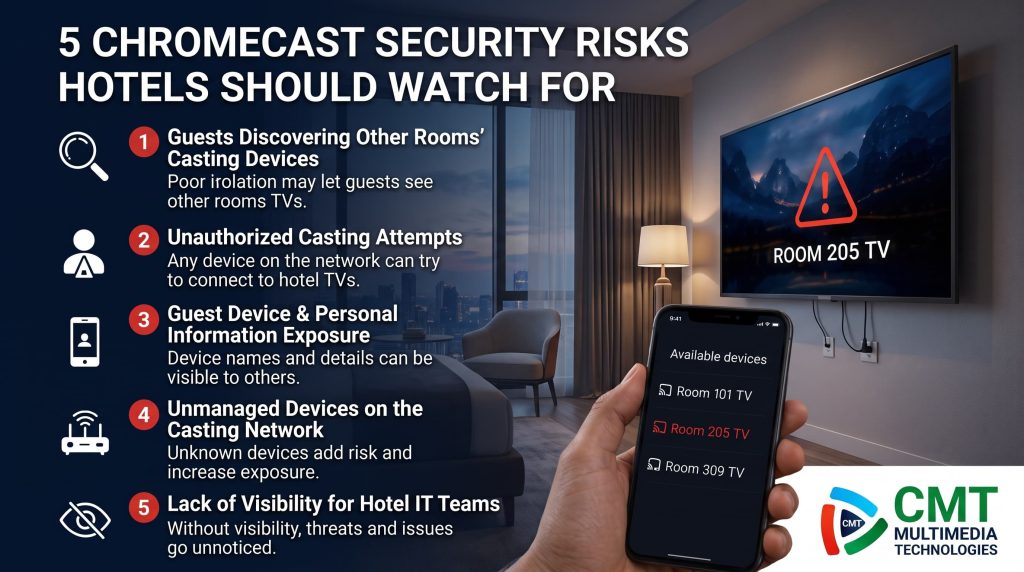
5 Chromecast Security Risks Hotels Should Watch For
1. Guests Discovering Other Rooms' Casting Devices: A Common Chromecast Security Risk
Poor network isolation allows devices to discover Chromecast receivers outside a guest’s own room. Consequently, a guest may see another room’s TV appear as a casting option.
This is more than an inconvenience. It is a genuine privacy problem for both guests involved.
Even a brief exposure can feel like a serious breach of trust. Guests rarely forget an experience like this, and many mention it in reviews.
2. Unauthorized Casting Attempts
An unauthorized guest, or even an outside device, may attempt to connect to a hotel TV. This risk is about access control, not complex technical exploitation.
Without proper controls, any device on the network can try to interact with any screen.
This risk grows during busy seasons, when hundreds of new devices join the network daily. Each new connection is another opportunity for an unauthorized attempt to slip through unnoticed.
3. Guest Device and Personal Information Exposure
Casting environments can reveal device names, casting destinations, and other identifiable details. For example, a phone’s name often includes the guest’s actual name.
So, hotels should minimize unnecessary visibility between guest devices at every level.
4. Unmanaged Devices on the Casting Network
Allowing unknown or unmanaged devices onto the same network adds real exposure. Because casting infrastructure often trusts anything on its network, this matters.
Controlling exactly which devices can communicate with casting infrastructure is essential.
This becomes harder when staff devices, IoT equipment, or third-party hardware share the same segment. Each unmanaged device adds a new point of uncertainty for the network.
5. Lack of Visibility for Hotel IT Teams
Security becomes much harder when administrators cannot see connected devices. Without visibility, unusual activity often goes unnoticed until a guest complains.
Centralized monitoring, therefore, matters for both troubleshooting and genuine security management.
Without it, IT teams often learn about a problem only after a guest complains. By then, the experience has already suffered.
Why Chromecast Security Deserves Special Attention in UAE Hotels
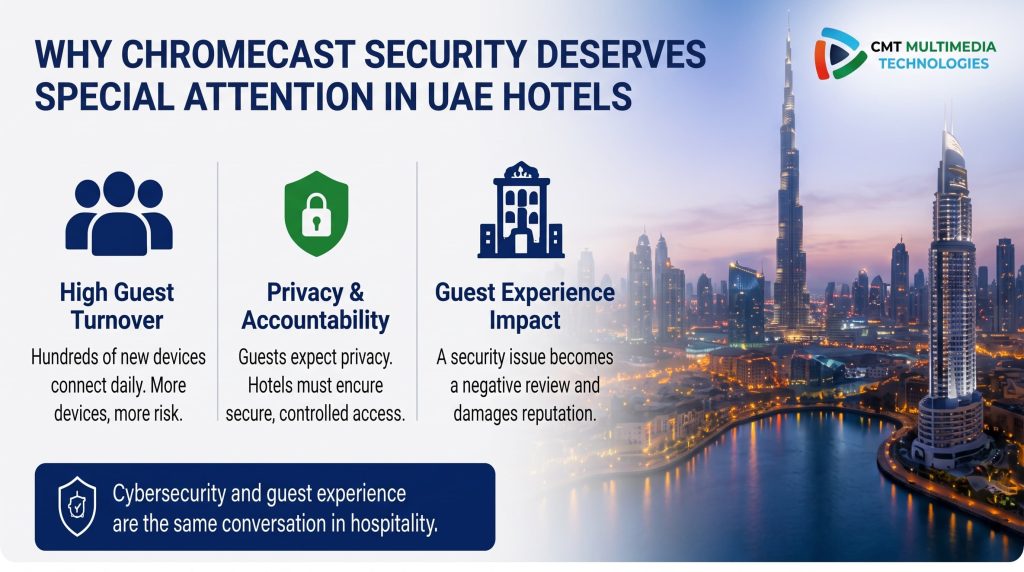
High Guest Turnover Creates a Bigger Management Challenge
UAE hotels may see hundreds of different guest devices connecting and disconnecting daily. A network that works fine for a handful of devices often struggles at this scale.
As guest volume grows, so does the surface area for chromecast security risks to appear.
Unlike a typical office network, hotel networks rarely see the same devices twice. This constant turnover makes long-term device trust nearly impossible to rely on.
Privacy and Network Accountability Matter
Guests expect their devices and content to stay private during their stay. So, hotels must protect guest privacy while maintaining controlled network access at all times.
This is about responsible network management, not a specific legal claim.
How a Chromecast Security Risk Becomes a Guest-Experience Problem
A guest seeing another room’s TV, or failing to cast securely, damages trust fast. In a market like the UAE, guest experience is closely tied to reputation.
Ultimately, cybersecurity and guest experience are the same conversation in hospitality.
How Hotels Can Secure Their Chromecast Environment
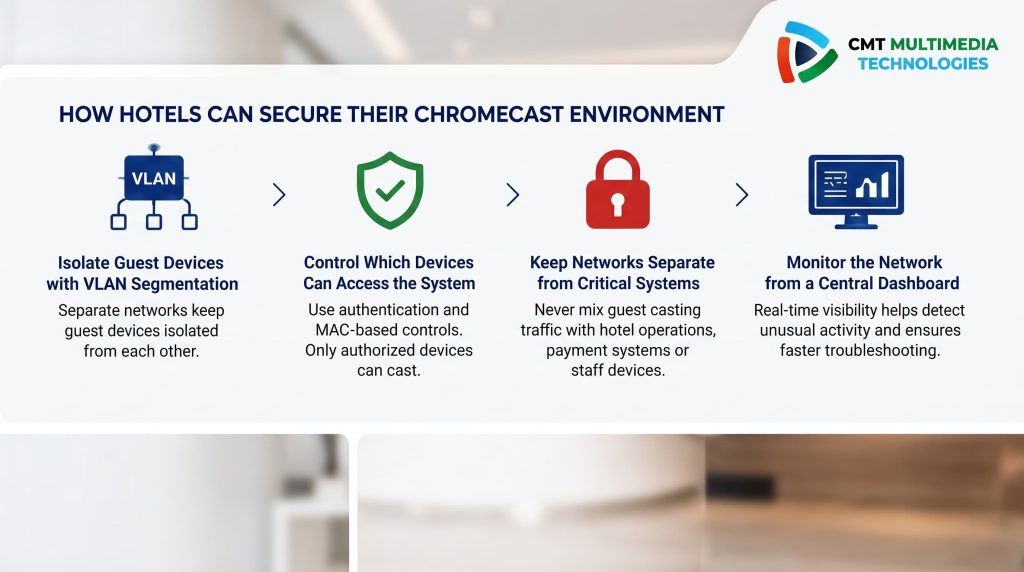
Isolate Guest Devices With VLAN Segmentation
VLAN segmentation splits network traffic into separate, controlled lanes. As a result, guest devices in one VLAN cannot freely reach devices in another.
This segmentation is the foundation of any secure hotel casting architecture.
Control Which Devices Can Access the Casting System
Access control relies on authentication and device identification, often through MAC-based controls. The core principle stays simple: only authorized devices should reach the intended casting infrastructure.
Keep Casting Networks Separate From Critical Hotel Systems
Guest entertainment traffic should never sit on the same network as sensitive hotel systems. This includes administration tools, payment systems, and staff devices.
Therefore, separating these networks limits the damage of any single security incident.
Monitor the Network From a Central Dashboard
Centralized visibility helps IT teams spot connected devices and unusual activity quickly. This kind of monitoring leads to faster troubleshooting and stronger overall network control.
It also gives management a clear, real-time picture of how the casting system performs across the entire property.
How CMT Technologies Secures Chromecast for Hotels
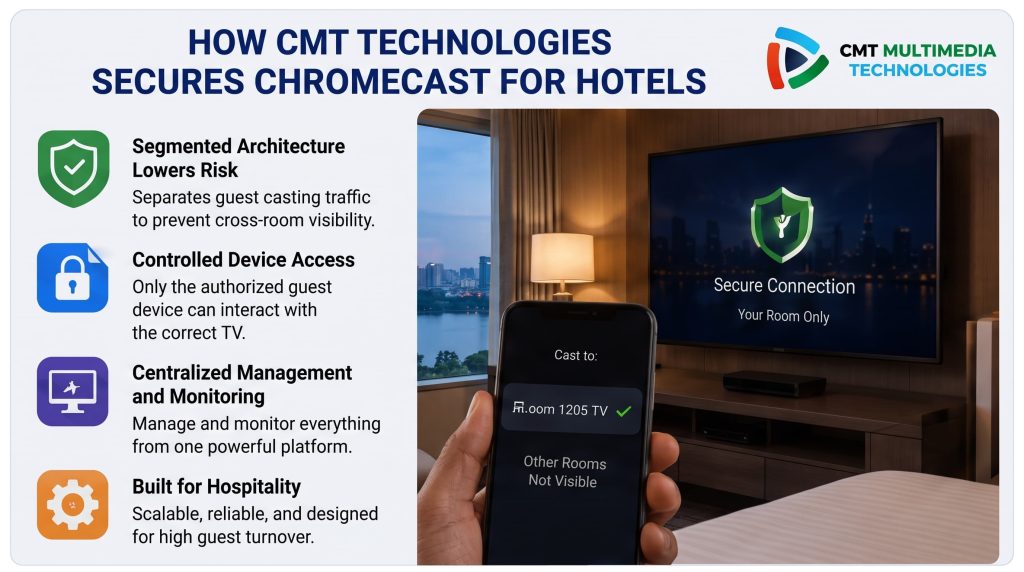
CMT Technologies addresses chromecast security risks through managed hospitality infrastructure, not a simple installation. In other words, CMT positions itself as a complete IPTV and casting solution.
Controlled Device Access
Access controls ensure that only the correct guest device interacts with its intended TV. So, casting stays private and predictable for every guest.
Centralized Management and Monitoring
Administrators can manage and monitor the entire casting environment from one platform. This gives hotel IT teams the visibility that flat networks simply cannot offer.
Built to Manage Chromecast Security Risk in Hospitality
CMT’s Chromecast Solution is built for scalability and high guest turnover. It also matches the operational needs of real hotel IT teams, not generic office networks.
Connect with CMT Technologies
Contact us via our website to schedule your personalized demonstration.
Demo
Chromecast Security Checklist for UAE Hotels
Use this checklist to evaluate your current setup:
- Guest devices are isolated from one another
- Guests cannot discover TVs in other rooms
- Casting access is controlled and authenticated
- Guest networks are separated from hotel operational systems
- Hotel IT teams can monitor connected devices in real time
- Unauthorized casting attempts can be identified and managed
- The casting environment can scale as guest numbers increase
For broader context on regional network expectations, the UAE’s Telecommunications and Digital Government Regulatory Authority publishes general guidance on network accountability. Hotels operating in the UAE should stay familiar with these expectations.
Running through this checklist regularly helps hotel IT teams catch gaps before guests ever notice them. A quarterly review is often enough to keep pace with new devices and evolving threats.
Final Thoughts: Secure Casting Starts With the Network
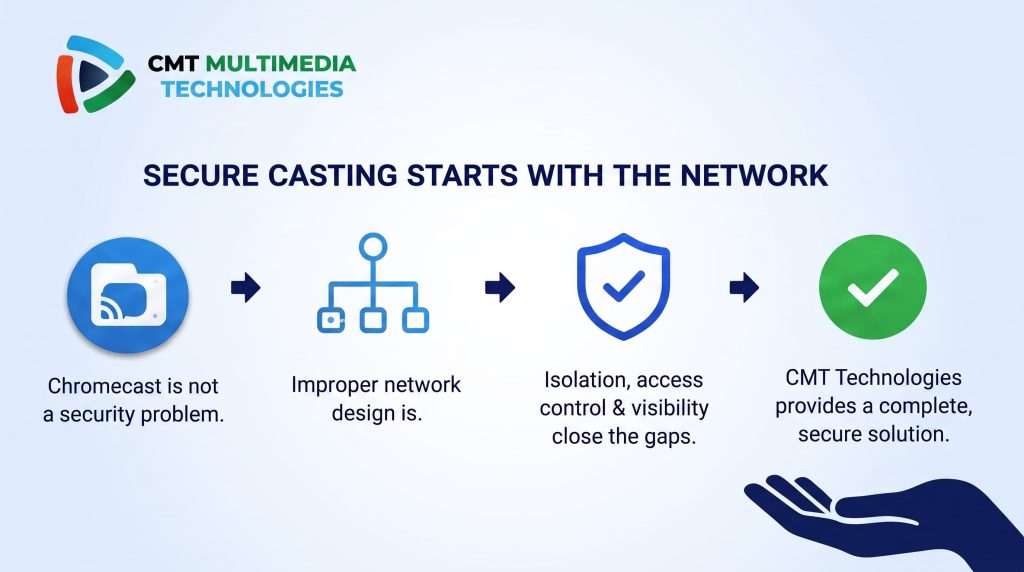
Chromecast is not automatically a security problem. However, an improperly designed casting network is. That distinction matters for every hotel evaluating chromecast security risks today.
Hotels need isolation, controlled access, and centralized visibility to close these gaps. Anything less leaves both guest privacy and hotel reputation exposed.
CMT Technologies builds all three protections into one managed solution. See how CMT Technologies’ Chromecast Solution secures guest casting from day one.
Frequently Asked Questions
Is Chromecast safe to use in hotels?
Chromecast itself is safe. However, the network around it must be properly segmented and managed to avoid chromecast security risks.
Can a hotel guest cast to the wrong room?
Yes, this can happen on flat, unsegmented networks. Guest casting wrong room in hotel setups usually comes from poor VLAN isolation, not the Chromecast device itself.
What is the biggest chromecast security risk in hotels?
Unauthorized casting attempts and cross-room device discovery are the most common risks. Both stem from weak network isolation and missing access controls.
How does CMT Technologies prevent unauthorized casting?
CMT uses VLAN segmentation, hidden SSIDs, and MAC address binding. Together, these controls ensure only the correct guest device can reach its assigned TV.
Do UAE hotels need extra security measures for Chromecast?
UAE hotels face high guest turnover and strong reputational expectations. As a result, properties benefit from stricter network controls and centralized monitoring tools.