

Broadcast Encoder Qatar: HEVC, SDI and Multi-Channel Encoding for Hotels, Telecom and Media in 2026
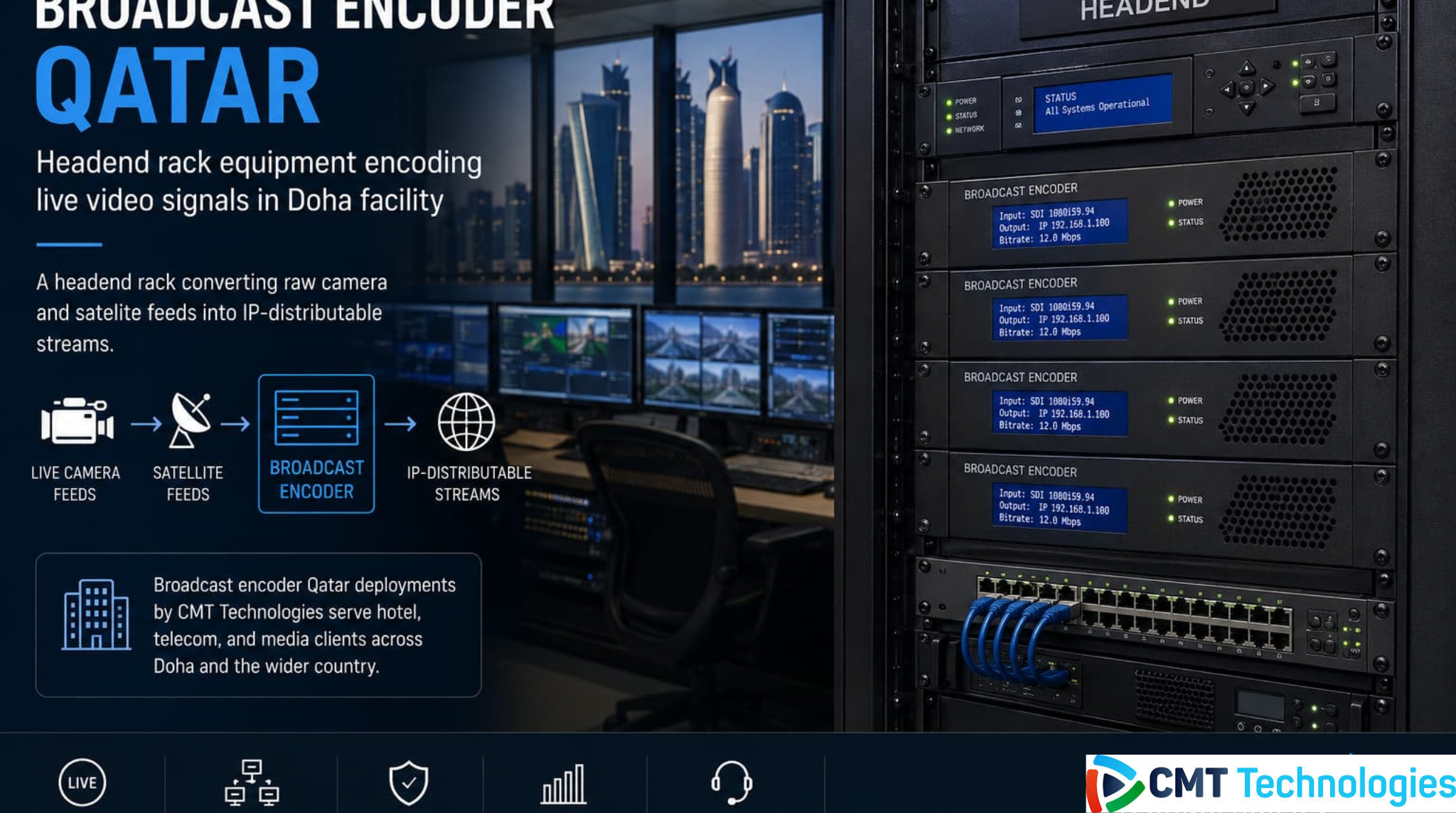
A broadcast encoder Qatar hotels, telecom operators, and media houses can rely on sits at the centre of every IPTV and live streaming deployment in the country. It converts raw camera and satellite signals into a format that can travel reliably across IP networks. Qatar's IPTV market is projected to exceed $200 million by 2027, growing at a CAGR of 12.3%. Doha alone accounts for roughly 75% of national demand. CMT Technologies builds its encoding deployments around this exact growth, pairing HEVC and H.264 encoding with the multi-channel headend infrastructure that hospitality and media clients across the country depend on daily.
Why Broadcast Encoder Qatar Demand Is Rising Across Doha
Qatar's broadcast and IPTV infrastructure market has grown steadily on the back of Qatar National Vision 2030, which prioritises digital transformation. This sits alongside extensive fibre-optic deployment across the country. Consequently, hotels, telecom operators, and media production houses are replacing ageing satellite-based headend equipment with IP-based encoding systems that support higher resolutions and far greater channel density. A broadcast encoder Qatar deployment sits right at the centre of this shift. It is the component that determines whether a property can actually deliver 4K content, multiple simultaneous channels, and low-latency live streams.
Moreover, Doha dominates national demand for broadcast and IPTV infrastructure, with hospitality and healthcare sectors leading adoption according to regional market research. Therefore, a hotel deployment in West Bay or The Pearl carries different requirements from a small regional property. Flagship Doha hotels frequently need to support several hundred simultaneous in-room streams from a single headend. This places far greater demand on encoder channel density and bitrate management than a smaller operation would ever encounter.
Projected Qatar IPTV market value by 2027.
CAGR forecast for the Qatar IPTV and broadcast infrastructure market.
Share of Qatar IPTV demand concentrated in Doha.
Target live latency benchmark for professional encoder deployments.
HEVC vs H.264 — Why Codec Choice Determines Bandwidth and Quality
The choice of video codec is the single most consequential technical decision in any encoding deployment, since it directly determines how much bandwidth a stream consumes for a given level of picture quality. H.264, also known as AVC, remains the industry standard for compatibility. It supports the widest possible range of set-top boxes and Smart TVs across a property. An HEVC setup, by contrast, uses the newer H.265 standard. This can reduce bandwidth consumption by up to 40 to 50 percent compared to H.264 for the same visual quality, depending on content type and bitrate settings.
Consequently, for any property delivering 4K content across many simultaneous streams, such as a 300-room hotel or a multi-channel telecom headend, HEVC is generally the more efficient long-term choice. This holds true even though it places slightly higher processing demand on the encoding hardware. As a result, CMT Technologies configures its broadcast encoder Qatar deployments to support both H.264 and HEVC simultaneously where needed. This allows a property to serve newer 4K-capable displays with HEVC while maintaining H.264 compatibility for older Smart TVs already installed on site.
SDI and HDMI — Matching Input Type to Source Equipment
Input connectivity is the second major technical decision in any encoder deployment. An SDI installation is built around serial digital interface connections, which use locking BNC connectors that resist accidental disconnection during live productions. SDI also maintains signal integrity over cable runs exceeding 50 feet, making it the standard choice for professional broadcast cameras and production switchers used by media houses across Qatar. An HDMI-based encoder, in contrast, connects more naturally to set-top boxes, satellite receivers, and consumer-grade sources commonly found in hotel headend rooms, though HDMI cable runs typically need to stay shorter to avoid signal degradation.
Many CMT broadcast encoder Qatar deployments combine both input types within a single multi-channel chassis. A hotel headend frequently needs to ingest satellite receivers over HDMI alongside a local production camera feed over SDI for an in-house channel showing property information or events.
Industries CMT Serves Across Qatar
Demand for encoder infrastructure in Qatar spans several distinct sectors. Each one carries different channel count, latency, and reliability requirements, which is why CMT tailors the configuration of every broadcast encoder Qatar deployment to the specific vertical it serves.
Hospitality, Telecom, Media and Healthcare Verticals
Hotel Encoding Infrastructure
Hospitality is one of the strongest drivers of demand across Doha. Hotels need to convert satellite and licensed content feeds into a multi-channel IPTV signal distributed to every guest room. A hotel deployment typically integrates with the property's existing hospitality IPTV system and broader hotel guest experience technology stack, supporting concurrent streaming to several hundred rooms from a single headend.
Telecom Operator Encoding
Telecom operators use multi-channel encoders as the foundation of their IPTV product offering. They convert incoming satellite and content feeds into the channel lineup delivered to residential and business subscribers. A deployment for a telecom operator needs to support a far higher channel count than a single hotel, often encoding dozens of linear channels simultaneously around the clock.
Media Production Encoding
Media production houses and broadcasters in Qatar rely on SDI-based encoders for live event coverage, sports production, and studio broadcast. Sub-second to sub-two-second latency is essential here, since it keeps the live feed synchronised with commentary and graphics overlays. These deployments prioritise low latency and signal redundancy above almost every other specification.
Healthcare Encoding Infrastructure
Healthcare facilities are a confirmed leading adoption sector for IPTV and encoding infrastructure in Qatar. They use encoded broadcast feeds to deliver patient entertainment and health information alongside existing patient communication systems, without disrupting clinical communication workflows already in place.
Streaming Protocols and Headend Integration
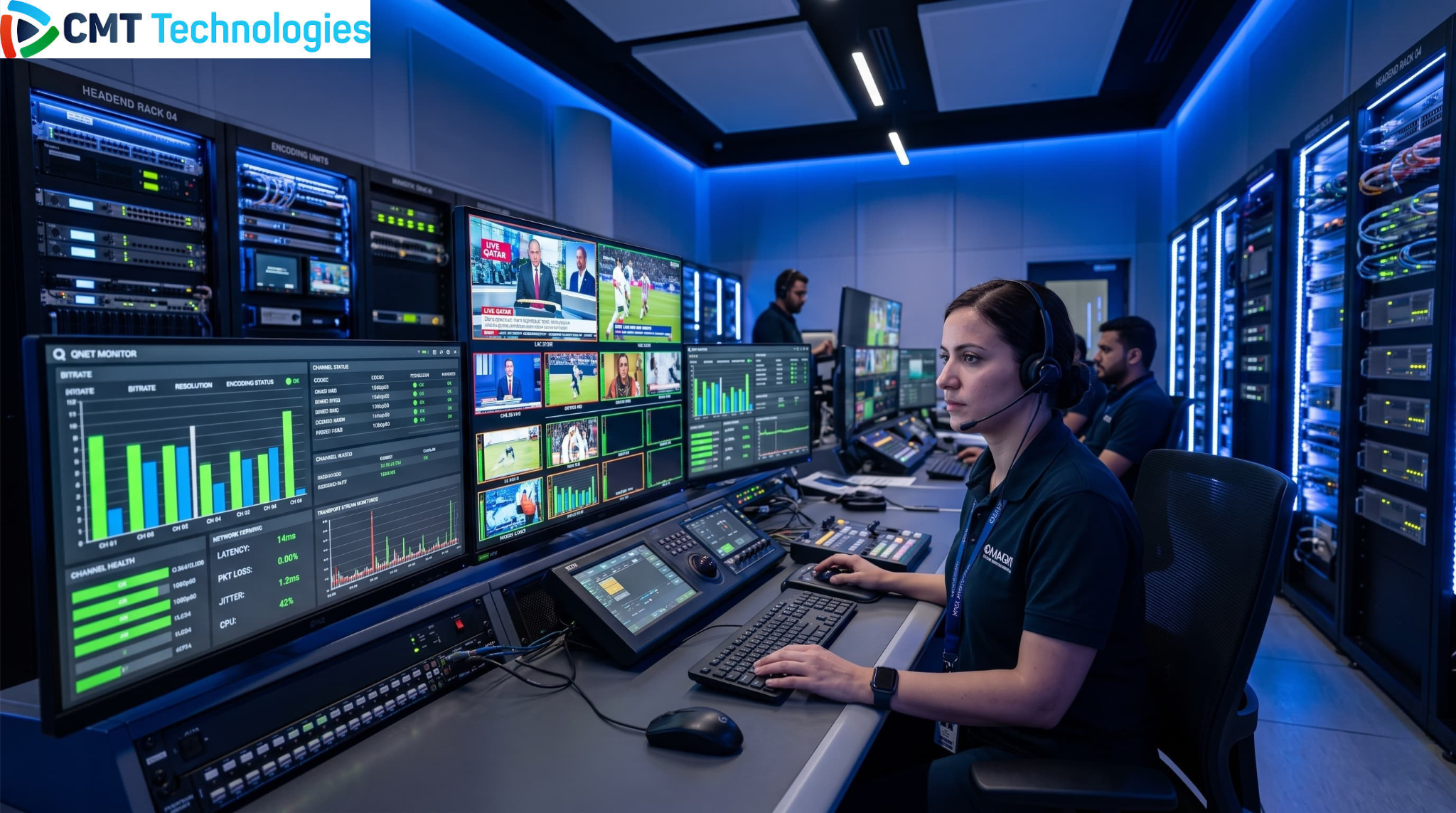
Once a signal has been compressed using H.264 or HEVC, it must be packaged into a streaming protocol before it can travel across an IP network. RTMP remains widely supported for delivering streams to media servers and platforms. SRT, meanwhile, has become the preferred protocol for contribution feeds over unpredictable network paths, since it actively recovers lost packets and maintains stream stability even when network conditions degrade mid-transmission. HLS is the standard choice for final delivery to Smart TVs, mobile devices, and set-top boxes, since nearly every modern playback device supports it natively.
Headend integration is equally important to get right. A broadcast encoder Qatar deployment rarely operates in isolation. Instead, it needs to feed into middleware that handles electronic programme guide data, channel numbering, and subscriber or guest authentication. In hospitality settings it frequently needs to coordinate with the property's PMS, so premium channel access can be billed correctly to a guest folio. CMT Technologies configures encoder output directly into its broader IPTV middleware stack, which already powers deployments such as the IPTV for serviced apartments solution and the hospitality signage work referenced in the hospital digital signage Makkah project. As a result, the encoder layer is never left to operate as a disconnected piece of hardware.
| Protocol | Best Use Case | Key Strength |
|---|---|---|
| RTMP | Streaming to media servers and platforms | Wide legacy compatibility |
| SRT | Contribution feeds over unstable networks | Packet loss recovery |
| HLS | Final delivery to TVs and mobile devices | Near-universal playback support |
Regulatory and Reliability Requirements in Qatar
Any deployment distributing licensed content commercially must operate within the framework set by Qatar's Communications Regulatory Authority. The CRA governs broadcasting standards, content filtering requirements, and quality of service expectations for IPTV and broadcast infrastructure in the country. Consequently, hotels, telecom operators, and media companies should confirm that their headend configuration meets CRA expectations before going live, rather than treating compliance as a post-launch concern.
Reliability requirements are equally strict in practice, even where not formally mandated. Industry benchmarks commonly cite a minimum 99.9% uptime SLA and sub-two-second live latency as the baseline expectation for professional hospitality and broadcast deployments in the region. CMT Technologies designs its broadcast encoder Qatar installations with redundant channel paths and continuous bitrate monitoring specifically to meet these benchmarks. An outage in a 300-room hotel, or across a telecom operator's channel lineup, affects every connected viewer simultaneously, not just one.
The right question when evaluating a broadcast encoder Qatar vendor is not simply which codec the hardware supports. It is whether the vendor can deliver multi-channel HEVC and H.264 encoding, flexible SDI and HDMI input, CRA-compliant configuration, and a guaranteed uptime SLA. All of this should be integrated into existing headend and PMS infrastructure, rather than installed as a standalone box. CMT Technologies has delivered this kind of broadcast and IPTV infrastructure across Doha and the wider GCC for over a decade.
Frequently Asked Questions — Broadcast Encoder Qatar
What does a broadcast encoder Qatar hotels typically need to support?
Is an IPTV encoder in Doha different from one used elsewhere in Qatar?
Why would a property choose HEVC over H.264?
What channel capacity does a telecom operator need from a broadcast encoder Qatar deployment?
Does CMT Technologies provide ongoing support after installation?
A broadcast encoder Qatar deployment sits at the foundation of every IPTV, hospitality, and media broadcast system operating in the country. Getting the codec, input type, and headend integration right at the outset prevents far more costly problems later. With Qatar's IPTV market on track to exceed $200 million by 2027, and Doha continuing to account for the bulk of national demand, hotels, telecom operators, and media companies that invest in properly configured multi-channel infrastructure now position themselves to handle that growth. Otherwise, they risk rebuilding their headend from scratch within a few years.
CMT Technologies has delivered this kind of infrastructure across Doha and the wider GCC, integrating encoding hardware directly into hospitality, telecom, and healthcare headend systems. Contact the team below to discuss a broadcast encoder Qatar deployment for your property or network.
Ready to Deploy a Broadcast Encoder in Qatar?
CMT Technologies delivers HEVC, H.264, SDI, and HDMI encoder solutions across Doha and Qatar — multi-channel, CRA-compliant, and backed by a 24/7 SLA.